Governance
HOA Architectural Review Committee Responsibilities
What an HOA architectural review committee does, where its authority comes from, how it should meet and decide, and mistakes that get decisions overturned.
HOAlyst Team · · 7 min read
An HOA architectural review committee (often called the ARC, the architectural control committee or the design review committee) reviews owners' requests to change the outside of their homes and decides them against the association's written standards. Its core responsibilities are to apply the declaration and the published architectural guidelines, review every complete request on time, decide the same kind of request the same way for every owner, put each decision in writing with the reason, keep records, and help the board enforce approvals that are not followed. What it may not do is invent rules the governing documents do not give it, or decide things the documents reserve to the board.
Architectural standards touch almost every owner sooner or later. The Foundation for Community Association Research estimates there are 373,000 community associations in the U.S., and in most of them the architectural committee is the body owners deal with most after the board itself.
This article is general information, not legal advice. Your state's law and your association's governing documents (the declaration or CC&Rs, the articles, the bylaws, the committee charter and any architectural guidelines the declaration authorizes) decide who sits on the committee, what it reviews, how fast it must answer and whether the board can overrule it. Where we quote a statute, it is an example from one state. Ask your association's attorney before changing the committee's authority or denying a request you expect to be challenged.
Where the committee gets its authority
An architectural committee has only the power the governing documents give it. Usually the declaration creates the committee (or lets the board create one), says what kinds of changes need approval, and lets the board or committee adopt more detailed design guidelines. The bylaws or a board resolution may set how members are appointed, how many serve and for how long. Some declarations give the committee the final word; others make it advisory, with the board deciding, or let owners appeal a committee decision to the board.
State law can narrow that authority. In Florida homeowners' associations, the power of an association or its architectural committee to review the location, size, type or appearance of an improvement is permitted only to the extent that the authority is specifically stated or reasonably inferred in the declaration or in published guidelines the declaration authorizes (Fla. Stat. § 720.3035(1)(a)). A committee that relies on an unwritten "policy" is on weak ground.
Before anything else, a new committee member should read the declaration's architectural article, the current guidelines, the committee charter or board resolution, and any appeal procedure.
Core responsibilities
- Review requests. Check each request for completeness, ask for missing items in writing, and decide it against the written standards.
- Meet the response deadline. Many declarations set a period after which a request is deemed approved if the association has not answered. Track the date each complete request arrived.
- Apply the standards consistently. Similar projects should get similar answers, whoever the owner is.
- Put every decision in writing: approved, approved with conditions, more information needed, or denied, with the specific guideline relied on for a denial.
- Keep the guidelines current. Recommend updates to the board when materials, products or state law change, rather than quietly deciding requests differently.
- Inspect completed work where the documents allow, and report unapproved or nonconforming work to the board or manager.
- Keep records: the request, attachments, each member's review, the decision letter and any inspection notes.
- Answer owners' questions about the guidelines before they apply, so fewer requests are denied for avoidable reasons.
Our HOA architectural review form post includes a request form you can copy and a checklist for each request.
Applying the standards fairly
Consistency is the committee's most important duty, and some states write it into law. Florida requires an association or its architectural committee to reasonably and equitably apply and enforce on all parcel owners the architectural standards authorized by the declaration or its published guidelines (Fla. Stat. § 720.3035(1)(a)). If the documents give owners options for materials, size, design or location, the committee may not restrict an owner's choice among them (Fla. Stat. § 720.3035(2)).
Practical ways to stay consistent:
- Decide from the written guidelines, not from personal taste. If a reason for denial is not in the guidelines, it probably is not a reason.
- Keep a log of past decisions by project type, so the committee can see how it handled the last fence or paint color.
- If the committee wants to start deciding a type of request differently, recommend a guideline change to the board and apply it going forward.
- Record the reason for every condition and denial at the time of the decision.
What the committee may not do
Florida gives a useful example of limits. An association or its architectural committee may not adopt or enforce a rule that limits or places requirements on the interior of a structure that is not visible from the parcel's frontage, an adjacent parcel, an adjacent common area or a community golf course, and may not require a building permit as a condition of reviewing a request (Fla. Stat. § 720.3035(1)(b)-(c)). The same section requires adopting hurricane protection specifications and bars denying an application that conforms to them (Fla. Stat. § 720.3035(6)).
Other common limits, depending on your state and documents:
- State laws that protect certain items, such as solar panels, flags or electric vehicle chargers, from outright bans.
- Federal rules on satellite dishes and antennas, which limit what associations can restrict.
- Authority the documents reserve to the board, such as levying fines, which a committee usually cannot exercise on its own.
- Work outside the parcels the committee covers, such as common areas the board manages directly.
Meetings, notice and votes
Many owners are surprised that architectural committee meetings can be subject to the same open-meeting rules as the board. Florida's homeowners' association statute says its board-meeting rules also apply to meetings of any body vested with the power to approve or disapprove architectural decisions with respect to a specific parcel (Fla. Stat. § 720.303(2)(a)). It also bars directors from voting by proxy or secret ballot at board meetings and applies that rule to the same architectural bodies (Fla. Stat. § 720.303(2)(c)3).
Virginia's Property Owners' Association Act says all meetings of the board, including any subcommittee or other committee of the board where association business is discussed or transacted, are open to all members of record, and requires notice of committee meetings to be published where it is reasonably available to a majority of lot owners (Va. Code § 55.1-1816(A)-(B)).
If your state has rules like these, the committee should notice its meetings, let owners attend, vote in the open and keep minutes, just as the board does. Our guides to HOA board meeting notice requirements and HOA meeting minutes cover both.
Conflicts of interest
Committee members are neighbors deciding neighbors' requests, so conflicts come up often. A member should step aside from a request when it is their own, a relative's, a neighbor's they are in a dispute with, or a project their business would build or supply. The member should say so and not take part in the discussion or vote, and the minutes or review record should show the recusal. Check your bylaws and any conflict-of-interest policy for the exact rule.
Working with the board and the manager
The board usually appoints the committee, adopts its guidelines and handles enforcement. A clear division of work helps:
- The manager or a committee member checks requests for completeness and tracks deadlines.
- The committee reviews and decides (or recommends, if the documents make it advisory).
- The board hears appeals where the documents allow them, and handles violations when work is done without approval or does not match what was approved.
When unapproved work turns up, the usual next step is a violation notice and, where your documents and state require it, a chance for a hearing. Our HOA violation letter template and guide to the HOA fine hearing cover that process.
Common mistakes
- Denying a request for a reason that is not in the written guidelines.
- Missing the response deadline, so a request is approved by default.
- Approving the same project for one owner and denying it for another without a written reason.
- Deciding by email or text among members instead of at a meeting, where open-meeting rules apply to the committee.
- Approving verbally, with nothing in writing for the owner or the file.
- Members voting on their own requests or a close friend's.
Where HOAlyst fits
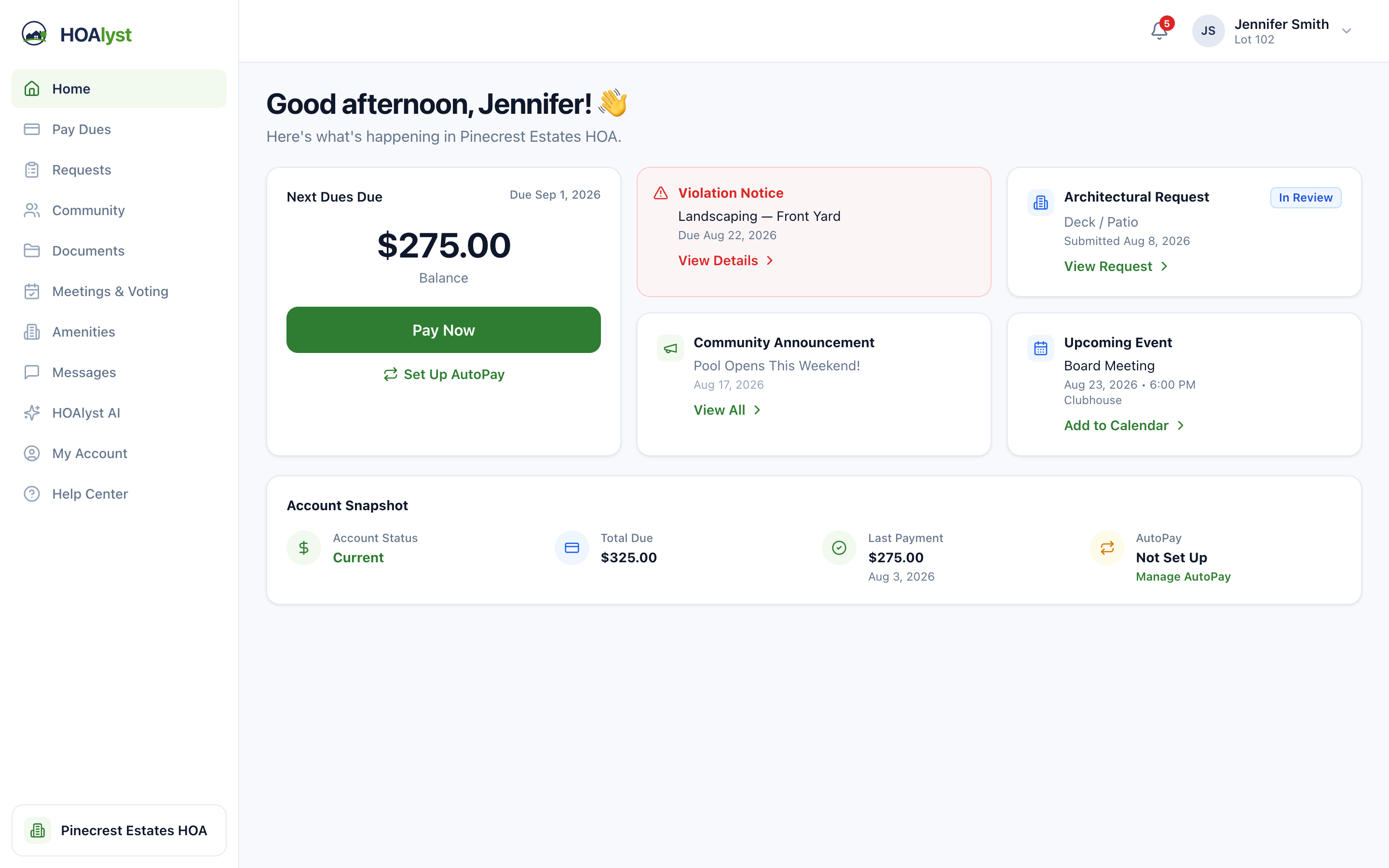
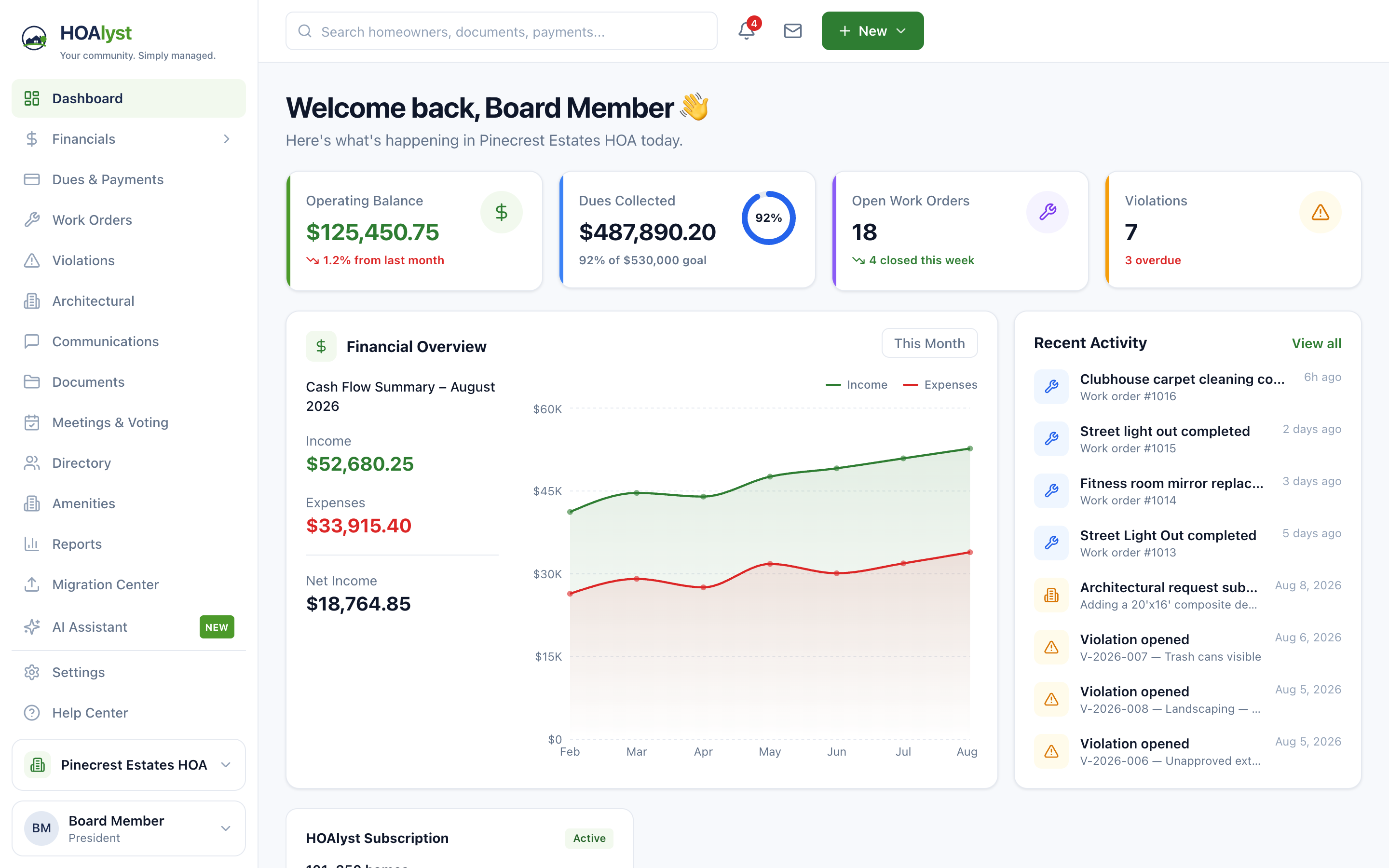
In HOAlyst, a board can set up an architectural committee and add members. When an owner submits an architectural request from the portal or mobile app, the board and the architectural committee members are assigned as reviewers. Each member records a review (approve, approve with conditions, request changes, deny, abstain, or recuse for a conflict of interest), and the board records the decision with written conditions and a decision letter the owner sees in their portal. Committee meetings can be scheduled with an agenda alongside board meetings. See what boards get or try the demo with a sample association.
Architectural committee checklist
- Declaration, guidelines, charter and appeal procedure read by every member.
- Response deadline and any deemed-approval rule known, and each request's arrival date tracked.
- State law checked for open-meeting rules and limits on what the committee can restrict.
- Meetings noticed and held in the open where required, with minutes.
- Requests decided from the written guidelines, the same way for every owner.
- Conflicts disclosed and members recused from their own or related requests.
- Every decision in writing, with conditions or the specific reason for a denial.
- Completed work inspected where allowed, and unapproved work reported to the board.
This article is general information for community association boards, not legal advice. Laws differ by state and change over time, and your association's declaration, bylaws and rules may set different requirements. Check your governing documents, and ask your association's attorney before acting on a specific situation.