Violations
HOA Violation Letter Template and Example
A free HOA violation letter template you can copy, a filled-in example, and what state law and your documents may require before a fine.
HOAlyst Team · · 7 min read
A good HOA violation letter names the owner and the property, describes what was seen and when, quotes the exact rule it breaks, says what the owner must do and by what date, explains what happens next if nothing changes, and tells the owner how to respond or ask for a hearing. It is calm, specific and short. Below is a template you can copy, a filled-in example, and the steps that usually have to come before any fine.
Enforcing rules is one of the most common jobs a board has, and one of the easiest to get wrong. The Foundation for Community Association Research estimates there are 373,000 community associations in the U.S., and in most of them the letters are written by volunteers. A vague or angry letter invites a dispute; a clear one usually ends the problem.
This article is general information, not legal advice. Your state's law and your association's governing documents (the declaration or CC&Rs, the bylaws and the rules the board has adopted) decide what a violation notice must say, how it must be delivered, and whether and how the association may fine. Where we quote a statute, it is an example from one state. Ask your association's attorney before sending a notice that starts a fine or a suspension.
Courtesy letter, violation letter, hearing notice: know which you are sending
Most associations use a ladder of letters, and each one has a different job:
- A courtesy or friendly reminder letter: the first contact, often for a minor issue such as trash cans left out. No fine is mentioned beyond noting that the rule exists.
- A formal violation letter (first notice): states the violation, the rule and a cure date, and explains what will happen if it is not corrected.
- A second or final notice: sent when the cure date passes, and often the letter that offers or schedules a hearing.
- A hearing notice: the formal notice of the owner's right to be heard before a fine or suspension. Some states set exact rules for this one.
- A decision letter: the result of the hearing, any fine, the payment date and how to cure.
Check your documents for a written enforcement policy. Many associations adopt one that sets the number of letters, the cure periods and the fine schedule, and following it every time is your best protection against a claim of selective enforcement.
What every HOA violation letter should include
- The date of the letter and the owner's name and property address, sent to the mailing or email address in the association's records.
- What was observed, where and when, written as facts ("a boat trailer parked in the driveway on March 3 and March 10"), not opinions.
- The exact provision violated: document, article and section, quoted word for word.
- What the owner must do to fix it, and a specific cure date.
- What happens if it is not fixed, such as a further notice, a hearing or a fine, stated only as your documents and state law allow.
- How the owner can respond, explain or dispute the notice, and whom to contact.
- The owner's right to a hearing, if your state or documents require it to be in the notice.
- Who is sending it: "the Board of Directors" or the manager on its behalf, not a single neighbor.
Keep a copy of every letter, the date and method it was sent, and any photos or notes from the inspection. If the matter ever reaches a hearing or court, that file is the record.
HOA violation letter template
Adapt this to your documents and your state. Copy it into Word or your email, and replace each bracketed item:
- [Association name] Board of Directors, [association mailing address].
- [Date]. Sent by [mail / email / certified mail] to: [Owner name], [property address].
- Re: Notice of violation, [property address], case number [number].
- Dear [Owner name]: On [date or dates], the association observed [specific description] at [location on the property].
- This appears to violate [document name], [article and section], which states: "[exact wording of the rule]."
- To correct this, please [specific action] by [cure date].
- If the violation is not corrected by that date, the board may [next step allowed by your documents and state law, such as scheduling a hearing to consider a fine of up to $(amount)].
- If you believe this notice is in error, or you need more time, please contact [name] at [phone / email] by [date]. [If required: You have the right to a hearing before (body) on (date, time, place or video link).]
- Thank you for helping keep [community name] a good place to live. Sincerely, [name], on behalf of the Board of Directors.
Leave out threats, sarcasm, comments about the owner and anything you could not prove. A letter may be read aloud at a hearing, so write it as if it will be.
Example: a first violation letter, filled in
Here is how the template reads for a common issue. The names and details are placeholders, not a real case:
- Re: Notice of violation, 123 Sample Lane, case number 2026-014.
- Dear Owner: On two inspections, on the 3rd and the 10th of this month, the association observed a utility trailer parked in the driveway of 123 Sample Lane.
- This appears to violate the Declaration, Article VII, Section 4, which states: "No boat, trailer, camper or recreational vehicle may be kept on any lot except within an enclosed garage."
- To correct this, please move the trailer into the garage or off the property within two weeks of the date of this letter.
- If the violation is not corrected by then, the board may schedule a hearing to consider a fine under the association's adopted fine schedule. You will receive written notice of that hearing.
- If you believe this notice is in error, or you need more time, please reply to this email or call the management office before the cure date.
Example: what state law can require before a fine
Some states spell out the process. Florida's homeowners' association statute lets an association levy reasonable fines, but it says a fine may not exceed $100 per violation, or $1,000 in total for a continuing violation, unless the governing documents provide otherwise (Fla. Stat. § 720.305(2)). Before a fine or suspension, the board must give at least 14 days' written notice of the owner's right to a hearing. The hearing must be held within 90 days before a committee of at least three members who are not officers, directors or employees of the association, or their close relatives. The notice must describe the violation, the specific action needed to cure it, and the hearing date and location (Fla. Stat. § 720.305(2)(b)).
The Florida statute adds limits that shape the letters that follow. If the violation is cured before the hearing, or in the way the notice specified, no fine or suspension may be imposed. The committee must send its findings in writing within 7 days after the hearing, and if it approves a fine, the payment date must be at least 30 days after that notice is delivered (Fla. Stat. § 720.305(2)(d)-(f)). A suspension of common area rights may not block access to the parcel, including the right to park (Fla. Stat. § 720.305(2)(a)).
Virginia takes a different approach. Its Property Owners' Association Act lets a board assess charges for violations only to the extent the declaration or rules expressly provide, and only after the owner gets written notice and a reasonable opportunity to correct the violation (Va. Code § 55.1-1819(B)-(C)). If it remains uncorrected, the owner must be given an opportunity to be heard and to be represented by counsel. Notice of the hearing must be hand delivered or sent by registered or certified mail, return receipt requested, at least 14 days before the hearing, and the result must be delivered the same way within 7 days after.
Virginia also caps the amount: charges may not exceed $50 for a single offense or $10 per day for a continuing one, and a continuing offense may not be charged for more than 90 days (Va. Code § 55.1-1819(D)). If your state has rules like these, your letters should be built around them, because a fine imposed without the required notice may not stand.
Delivery and timing
Send each letter the way your documents and state law require. Many allow first-class mail or email to the address in the association's records; some require certified mail or hand delivery for hearing notices. Give a realistic cure period: a few days for trash cans, longer for repainting or landscaping. If an owner asks for more time and is making a good-faith effort, a written extension often costs the board nothing and avoids a hearing.
Consistency is the whole game
The most common defense to an HOA violation is that the board enforces the rule against some owners and not others. Inspect on a schedule, apply the same ladder of letters to every similar violation, and record every step. When the board decides a rule is no longer worth enforcing, change the rule through the proper process rather than quietly ignoring it. Decisions about fines belong on a board agenda; our HOA board meeting agenda template and guide to HOA executive session rules show where they fit, and our HOA meeting minutes guide covers how to record the vote.
Where HOAlyst fits
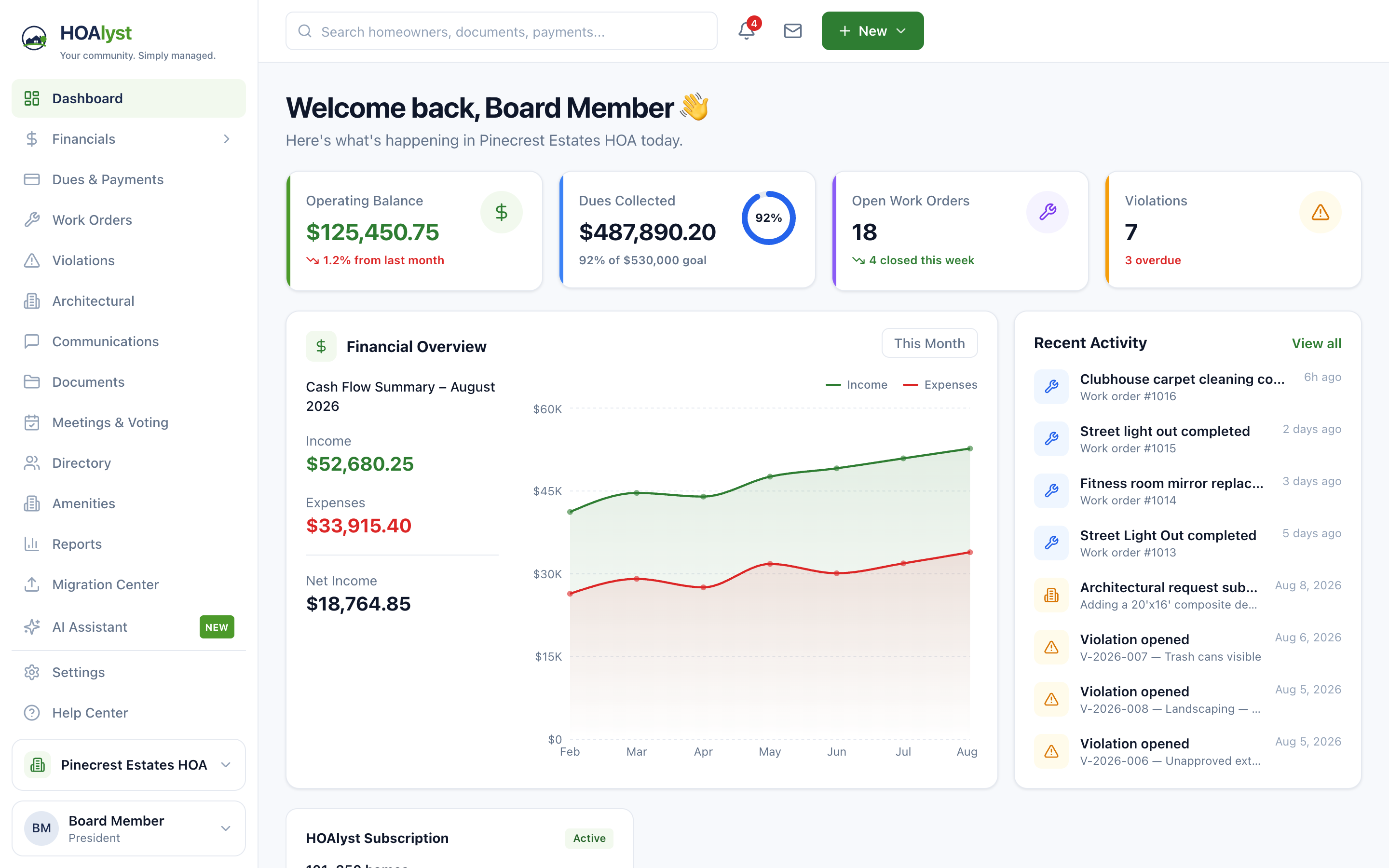
In HOAlyst, a board opens a violation case for a property, ties it to the exact section of the governing documents it relies on, and drafts each notice from courtesy letter to final notice and hearing notice. Notices are emailed to the owner and appear in their owner portal, where the owner can respond or dispute. The case tracks the cure date, any hearing and its outcome, a board-approved fine posted to the owner's account, and an appeal, with every step on one timeline. See what boards get or try the demo with a sample association.
Violation letter checklist
- Enforcement policy and fine schedule checked in your documents.
- State law checked for notice, hearing, delivery and fine limits.
- Facts, dates and location written down, with photos kept in the file.
- Exact rule quoted with document, article and section.
- Specific cure action and a realistic cure date.
- Next steps stated only as your documents and state law allow.
- How to respond, and the right to a hearing where required.
- Sent to the address of record by the required method, with a copy kept.
This article is general information for community association boards, not legal advice. Laws differ by state and change over time, and your association's declaration, bylaws and rules may set different requirements. Check your governing documents, and ask your association's attorney before acting on a specific situation.