Meetings
HOA Meeting Minutes: Requirements and a Template
What HOA board meeting minutes must include, what to leave out, how long to keep them, and when owners can see them, with a template you can copy.
HOAlyst Team · · 7 min read
HOA meeting minutes should record what the board decided, not what everyone said: the date, time and place, who attended, that a quorum was present, each motion and how it came out, and when the meeting ended. Many states add their own rules on top of that, such as recording how each director voted, keeping minutes for a set number of years, and letting owners inspect them. Your bylaws may add more.
Minutes are worth getting right because they are often the only lasting record of a board's decisions. The Foundation for Community Association Research estimates there are 373,000 community associations in the U.S. with 78.1 million residents, and in most of them a volunteer secretary writes the minutes. When a decision is questioned years later (a fine, a contract, a rule change), the minutes are what the association points to.
This article is general information, not legal advice. The rules that apply to your minutes come from your state's law and your own governing documents: the declaration (often called the CC&Rs), the bylaws, and any rules or resolutions the board has adopted. Where we quote a statute, it is an example, not a summary of the law everywhere. Ask your association's attorney before relying on any of it for a decision that matters.
What HOA meeting minutes must include
Start with your bylaws, which often say who keeps the minutes (usually the secretary) and how they are approved. Then check your state statute. Florida is a useful example of how specific a statute can be. For homeowners' associations, it requires that minutes of all board and member meetings be kept in written form, or a form that can be converted into writing, and that a vote or abstention on each matter voted upon for each director present be recorded in the minutes (Fla. Stat. § 720.303(3)). A Florida board that records only "motion carried" is not meeting that requirement.
Whatever your state says, minutes that hold up well usually contain:
- The name of the association and the type of meeting: regular board, special board, annual members, or committee.
- The date, the start time, and the place, including how remote attendees joined if your rules allow it.
- The directors present and absent, and other people present in a role (the manager, the attorney, an invited contractor).
- A statement that a quorum was present.
- Approval of the previous minutes, with any corrections.
- Each motion, worded as made, who made and seconded it if your rules require a second, and the result.
- How each director voted, where your state or bylaws require it, and any abstentions.
- Reports received (treasurer, committees), noted briefly, with the written report attached or referenced.
- A note that owners were given time to comment, if your rules provide for an owner comment period.
- Executive session: the stated purpose and the time the board went in and came out.
- The time of adjournment, and the signature or name of the person who took the minutes.
What to leave out
Minutes are not a transcript. The common mistake is writing down the discussion: who argued what, who raised their voice, what one director thinks of a contractor. That detail rarely helps the association and can be quoted back at the board in a dispute. Record the action and the reason in a sentence if the reason matters ("after reviewing three bids"), and stop there.
Also leave out anything said in executive session beyond what your state requires to be noted. Personnel matters, an individual owner's delinquency, and advice from the association's attorney are usually discussed privately for a reason. If the board takes a vote on one of those matters, the careful practice is to take it back in the open meeting and record the vote there, described without unnecessary personal detail.
Executive session and the minutes
Some states spell out exactly what the open minutes must say about a closed session. Virginia's Property Owners' Association Act requires a board to vote in an open meeting to go into executive session, on a motion stating the specific purpose, and reference to the motion and the stated purpose must be included in the minutes (Va. Code § 55.1-1816). The same statute says no action taken in executive session becomes effective until the board reconvenes in open session and votes on it.
Virginia also lets an association withhold meeting minutes or other confidential records of an executive session from member inspection (Va. Code § 55.1-1815). So a Virginia board ends up with two records: open minutes that note the motion, the purpose and any vote taken afterward, and confidential notes, if it keeps any, of the closed discussion. Check whether your state works the same way before assuming your closed-session notes are private.
Approving and correcting minutes
The usual cycle is: the secretary drafts the minutes soon after the meeting, circulates the draft to the directors for corrections, and the board approves them as the first business item at the next meeting. Corrections are made by motion and noted in the new minutes ("the minutes of the March meeting were approved as corrected"). Once approved, the minutes are not rewritten. A later correction goes in the minutes of the meeting that makes it.
Mark the draft clearly as a draft. Some states give owners access before approval, so a draft may be read by owners, and it should say what it is.
When owners can see the minutes
Many states treat minutes as association records that members may inspect. Virginia is specific about timing: draft minutes of the board of directors shall be open for inspection within 60 days of the meeting, or when they are distributed to the board as part of the agenda package for the next meeting, whichever comes first (Va. Code § 55.1-1815). Other states set different procedures for requesting records and different response times.
Even where the law asks for less, sharing approved minutes with every owner as a matter of routine tends to save time. Owners who can read what the board decided ask fewer questions, file fewer records requests, and are less likely to assume something is being hidden.
How long to keep them
Keep minutes for as long as your state and your documents require, and many associations keep them permanently, since they are the history of every rule, contract and assessment. Florida's statute for homeowners' associations lists the minutes of all meetings of the board of directors and of the members among the official records that must be maintained for at least 7 years, unless the governing documents require longer (Fla. Stat. § 720.303(4)). Store them where the next board will find them, not on a former secretary's laptop.
A minutes template you can copy
Adapt this outline to your bylaws and your state. Each line is a heading to fill in, in this order:
- [Association name]: minutes of the [regular / special] meeting of the board of directors.
- Date, time called to order, and location (and video or phone link, if used).
- Directors present; directors absent; others present and their role.
- Quorum: "A quorum of the board was present."
- Approval of minutes: "The minutes of the [date] meeting were approved [as written / as corrected]."
- Treasurer's report: received; report attached.
- Committee reports: received; reports attached.
- Owner comment period: held from [time] to [time].
- Motion: "[Director] moved to [action]. [Director] seconded." Vote: [names] in favor, [names] opposed, [names] abstaining. Motion [carried / failed].
- Executive session: "On a motion stating its purpose ([purpose]), the board went into executive session at [time] and returned to open session at [time]." Any resulting vote recorded as a motion above.
- Next meeting: [date].
- Adjourned at [time]. Minutes taken by [name], secretary.
Use the same template for every meeting. Consistency makes the minutes easy to search years later, and easy for a new secretary to pick up.
Keeping minutes in one place
Minutes go with the rest of the meeting record: the notice, the agenda and the board packet. Our guide on how to run an HOA board meeting walks through those steps from notice to adjournment.
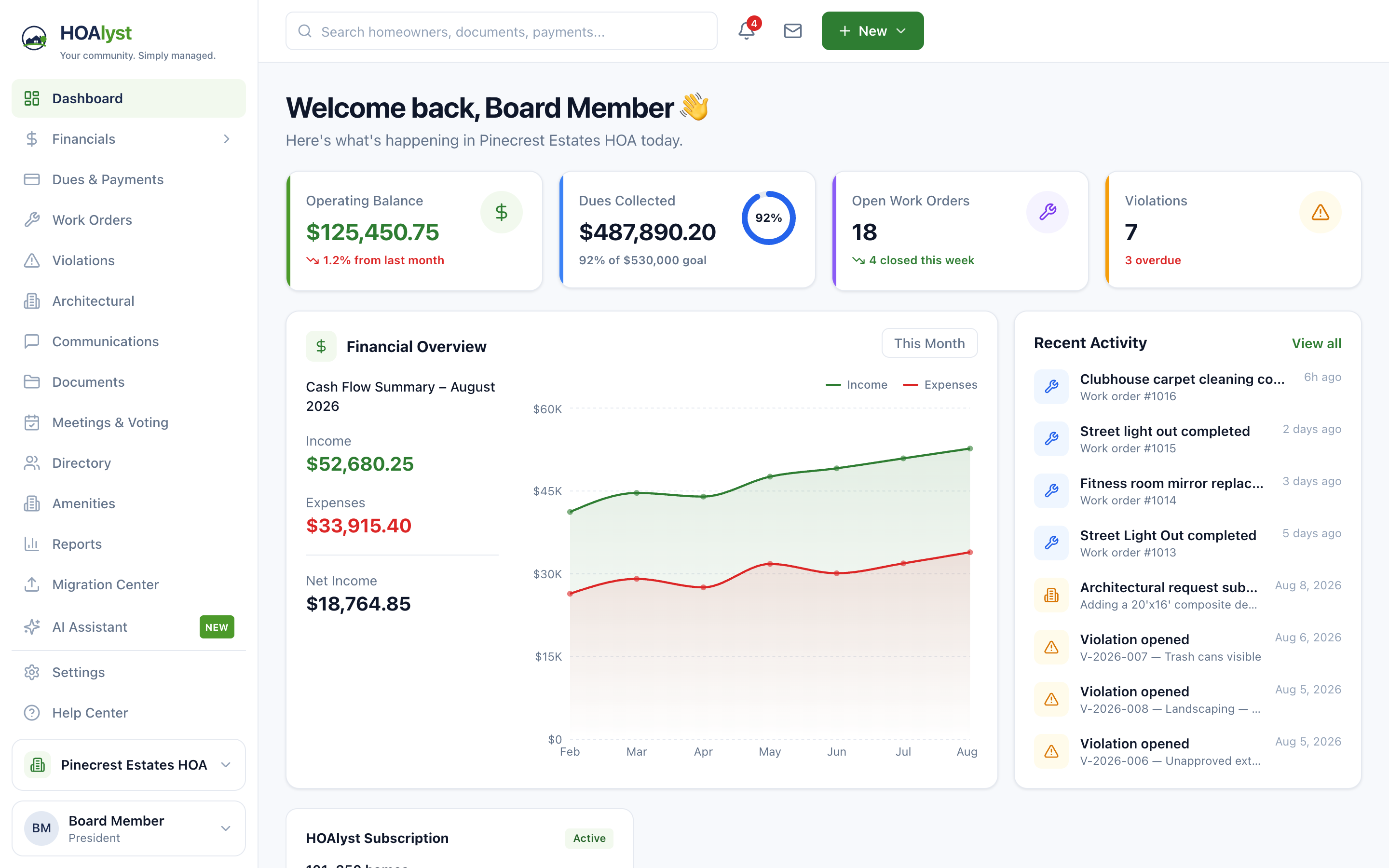
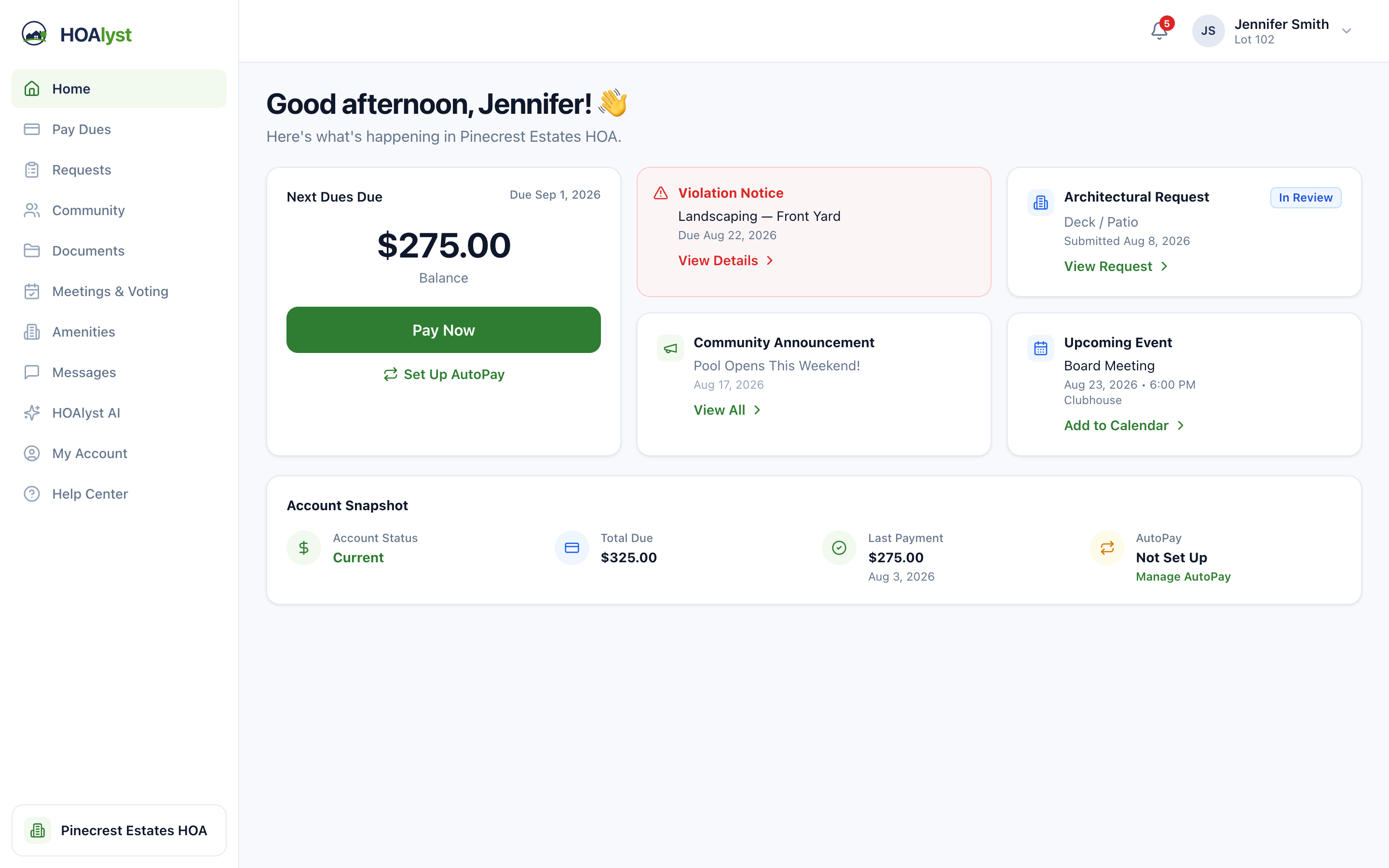
If your association is self-managed, HOAlyst can keep that record together. The board schedules each meeting with its agenda, drafts the minutes and publishes them once they're approved, and owners read the published minutes in their portal or the mobile app. See what boards get, or try the demo with a sample association.
Minutes checklist
- Bylaws and state statute checked for what minutes must contain and who may see them.
- Quorum, attendance, every motion and every result recorded.
- Each director's vote recorded where your state or bylaws require it.
- Discussion summarized in a sentence at most; no transcript.
- Executive session purpose noted in the open minutes; any vote taken in open session.
- Draft marked as a draft, approved at the next meeting, corrections noted.
- Approved minutes shared with owners and stored with the association records for as long as required.
This article is general information for community association boards, not legal advice. Laws differ by state and change over time, and your association's declaration, bylaws and rules may set different requirements. Check your governing documents, and ask your association's attorney before acting on a specific situation.