Meetings
HOA Annual Meeting Requirements: A Board Guide
Does an HOA have to hold an annual meeting? What the notice must say, what happens at it, elections, quorum, and what to do if it is missed.
HOAlyst Team · · 7 min read
Most HOAs and condo associations must hold a meeting of all the owners at least once a year. The requirement usually comes from the bylaws, and many state statutes repeat it. The annual meeting is where owners elect directors, hear how the association is doing, and take up any business the documents reserve for the members. The basic requirements are the same almost everywhere: hold it on the schedule the bylaws set, give owners proper notice, reach a quorum before voting, run the election by the rules, and record it all in minutes.
The rules reach a lot of households. The Foundation for Community Association Research estimates there are 373,000 community associations in the U.S., and most of them hold an annual meeting of owners.
This article is general information, not legal advice. Your state's law and your association's governing documents (the declaration or CC&Rs, the articles of incorporation, the bylaws and any adopted rules) control, and they vary a great deal. Where we quote a statute, it is an example from one state, not a statement of what applies to you. Ask your association's attorney before relying on any of this for a real decision.
Does an HOA have to hold an annual meeting?
In most cases, yes. Florida's homeowners' association statute is a clear example: the association shall hold a meeting of its members annually for the transaction of any and all proper business, at a time, date and place stated in or fixed under the bylaws, and the election of directors, if one is required, must be held at or in conjunction with the annual meeting or as the governing documents provide (Fla. Stat. § 720.306(2)).
Condominiums often have a similar rule. Virginia's Condominium Act says meetings of the unit owners' association shall be held under the condominium instruments at least once each year after the association is formed (Va. Code § 55.1-1949(A)(1)).
If your association is a nonprofit corporation, the nonprofit act may matter too. Florida's nonprofit corporation act leaves the frequency of member meetings, notice, conduct and quorum largely to the articles and bylaws, and says that failing to hold an annual meeting at the scheduled time does not dissolve the corporation or by itself affect the validity of corporate action (Fla. Stat. § 617.0701(1)-(2)). That is not permission to skip it. Directors' terms, elections and owners' rights often depend on the meeting happening.
Where to find your own requirements
- The bylaws: look for "annual meeting", "meetings of members" and "elections". They usually set the month or the window, who calls the meeting, the notice period and the quorum.
- The articles of incorporation: they sometimes set the number of directors, terms or voting rules.
- The declaration or CC&Rs: these may reserve certain votes to the owners, such as amendments or large expenditures.
- Your state's homeowners' association or condominium statute, and the nonprofit corporation act if the association is incorporated.
- Any election rules the board has adopted.
Where the statute and the documents differ, the statute usually wins on the points it covers, and the documents fill in the rest. Your attorney can tell you how that works in your state.
Notice of the annual meeting
Notice is the requirement boards most often get wrong. Florida's homeowners' association statute says that if the bylaws do not provide for notice, the association must give all parcel owners and members actual notice of all membership meetings, mailed, delivered or electronically transmitted not less than 14 days before the meeting, with an affidavit from the person who gave notice filed in the official records (Fla. Stat. § 720.306(5)). The same statute says that, unless the law or the documents require otherwise, notice of an annual meeting need not describe its purposes, while notice of a special meeting must (Fla. Stat. § 720.306(4)).
Florida condominiums have a stricter rule. Written notice of a condo annual meeting must include an agenda, be mailed, hand delivered or electronically transmitted to each unit owner at least 14 days before the meeting, and be posted in a conspicuous place on the property for at least 14 continuous days before it (Fla. Stat. § 718.112(2)(d)4).
Virginia condominiums need more lead time. The bylaws must name an officer or agent who sends each unit owner notice of the time, place and purposes of the meeting at least 21 days in advance of any annual or regularly scheduled meeting, and at least seven days in advance of any other meeting (Va. Code § 55.1-1949(A)(1)).
Those three examples give three different answers, which is the point: check your own state and bylaws, then give notice early enough to beat the longest deadline that could apply. Keep proof of when and how it went out. Our guide to HOA meeting notice requirements covers notice in more detail.
Quorum at the annual meeting
An annual meeting cannot take binding votes without a quorum of owners. In Florida homeowners' associations, unless the bylaws set a lower number, the quorum at a meeting of the members is 30 percent of the total voting interests (Fla. Stat. § 720.306(1)(a)). Your bylaws may set a different number, and condominiums often start from a majority.
Work out the exact number before the meeting, track RSVPs and proxies in the weeks before it, and count attendance at the start. If you fall short, your options usually include adjourning to a new date under the notice rule for adjournments, or holding an informational session with no votes. Our guide to HOA quorum requirements walks through those options.
Elections at the annual meeting
Director elections are usually the main business. Florida's homeowners' association statute says elections must follow the procedures in the governing documents, that an election is not required unless more candidates are nominated than there are vacancies, and that when it is not required (and floor nominations are not required) the qualified candidates commence service on the board of directors, regardless of whether a quorum is attained at the annual meeting. Unless the documents say otherwise, directors are elected by a plurality of the votes cast, and any challenge to the election process must be started within 60 days after the results are announced (Fla. Stat. § 720.306(9)(a)).
Florida condominiums add their own steps. At least 60 days before a scheduled election, the association must send each unit owner entitled to vote a first notice of the date of the election, and board members of a residential condominium are elected by written ballot or voting machine rather than by proxy in general elections (Fla. Stat. § 718.112(2)(d)5). That timeline runs well ahead of the 14-day meeting notice, so it needs its own date on the calendar.
Many associations also allow absentee ballots, mailed ballots or electronic voting for elections. Whether you can, and whether those ballots count toward a quorum, depends on your state and your documents. Confirm before you announce the method to owners.
What usually happens at an annual meeting
Your bylaws may list the order of business. A typical agenda looks like this:
- Call to order and confirmation that a quorum is present.
- Proof of notice.
- Approval of the last annual meeting's minutes, if the owners approve them.
- Reports: the president's report, the treasurer's or financial report, and committee reports.
- Election of directors, with the results announced.
- Any owner votes the documents call for, such as amendments.
- Owner comments. Florida, for example, gives members the right to speak at membership meetings on agenda items, for at least 3 minutes on any item, subject to reasonable written rules (Fla. Stat. § 720.306(6)).
- Adjournment.
Our HOA board meeting agenda template includes an annual-meeting version you can copy.
In person, remote or hybrid
Many states now allow some remote participation, but the rules are specific. Florida's condominium act says unit owner meetings, including the annual meeting, may be conducted in person or via video conference; if the annual meeting is held by video conference, a quorum of the board must be physically present at a physical location where owners can attend, and the video conference must be recorded and kept as an official record (Fla. Stat. § 718.112(2)(d)2). Other states have different rules, and some leave it to the bylaws. Check before scheduling a remote-only meeting.
Minutes and records
Take minutes of the annual meeting just as you would for a board meeting: who called it to order, that a quorum was present and how it was counted, the reports given, motions and how each vote came out, and the election results. Keep the notice affidavit, sign-in sheet, proxies and ballots with them for as long as your state and documents require. Florida's homeowners' association statute, for example, lists minutes of all meetings among the official records an association must keep (Fla. Stat. § 720.303(4)). Our guide to HOA meeting minutes has a template.
Where HOAlyst fits
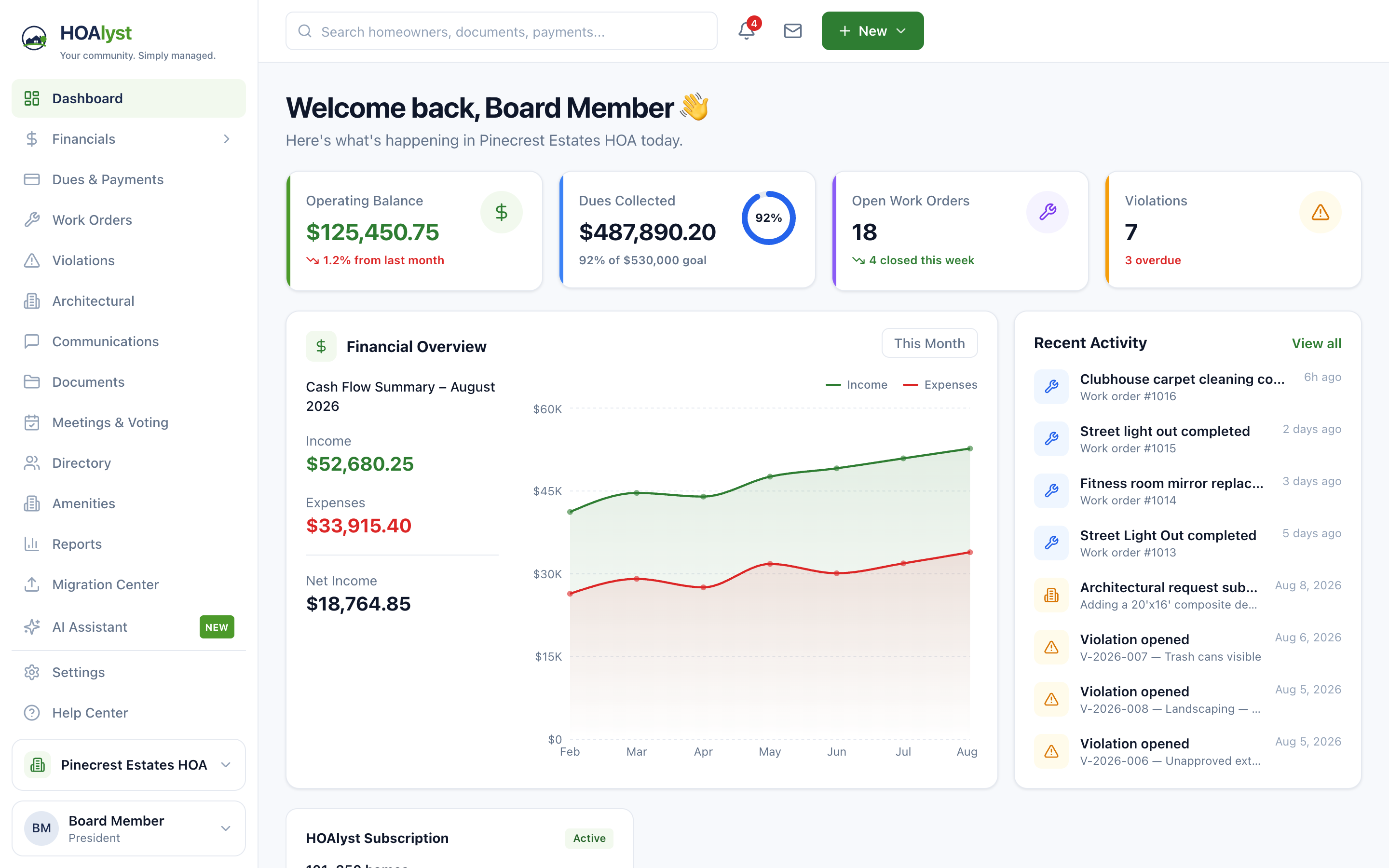
In HOAlyst a board creates the annual meeting as its own meeting type with an agenda, owners RSVP from the portal or the mobile app, and the board can run electronic votes that show votes cast against the eligible count and the quorum needed. After the meeting, the board publishes the minutes for owners to read in the portal. It does not decide your notice period, quorum or election procedure; your documents, state law and your attorney do. See what boards get or try the demo with a sample association.
Annual meeting checklist
- Bylaws, articles, declaration and state statute read for the annual meeting rules.
- Meeting date set inside the window the bylaws require.
- Election calendar built backward from the meeting, including any early election notice.
- Notice sent and posted by the longest deadline that could apply, with proof kept.
- Quorum number worked out; RSVPs and proxies tracked.
- Agenda, reports and ballots ready.
- Attendance counted at the start and before each vote.
- Minutes taken, with quorum, votes and election results recorded.
This article is general information for community association boards, not legal advice. Laws differ by state and change over time, and your association's declaration, bylaws and rules may set different requirements. Check your governing documents, and ask your association's attorney before acting on a specific situation.