Meetings
HOA Board Meeting Notice Requirements, Explained
How much notice an HOA board meeting needs, what the notice must say, how to deliver it, and the stricter rules for assessments and owner meetings.
HOAlyst Team · · 7 min read
HOA board meeting notice requirements come from two places: your state's statute and your association's bylaws. Together they usually answer four questions: how far ahead owners must be told, what the notice has to say, how it has to be delivered, and which meetings need more notice than usual. A common pattern is a short notice period for ordinary board meetings, a longer one for owner meetings, and extra notice when the board will vote on assessments or rule changes. Getting it wrong matters, because a decision made at a meeting that was not properly noticed is the easiest kind for an owner to challenge.
It is a question a lot of boards face. The Foundation for Community Association Research estimates there are 373,000 community associations in the U.S., most of them governed by volunteer boards that set their own meeting calendars.
This article is general information, not legal advice. The rules for your association come from your state's law and your governing documents (the declaration or CC&Rs, the bylaws and any rules the board has adopted), and they differ a great deal from state to state. Where we quote a statute, it is an example, not a statement of what applies to you. Ask your association's attorney before relying on any of this for a real decision.
Where the notice rules live
Start with the bylaws. Look for the sections on board meetings and member meetings; they usually set the notice period, who may call a special meeting, and how notice is given. Then find your state statute for homeowners or condominium associations. Many states have separate laws for each, and a condominium may be governed by a different act than a planned community down the street.
When the bylaws and the statute disagree, the statute usually controls where it sets a minimum, and the bylaws can require more. Some statutes also fill a gap: if the bylaws say nothing about notice, the statute supplies a default. The safe working rule is to meet whichever requirement is stricter.
How much notice a board meeting needs
There is no single national rule. Two states show how different the answers can be. Florida's homeowners' association statute says that, unless the bylaws provide otherwise, notices of board meetings must specifically identify agenda items and be posted in a conspicuous place in the community at least 48 hours in advance, except in an emergency, or be mailed or delivered to each member at least 7 days before the meeting (Fla. Stat. § 720.303(2)(c)). Florida's condominium act likewise requires notice that specifically identifies all agenda items, posted conspicuously on the condominium property at least 48 continuous hours before the meeting, except in an emergency (Fla. Stat. § 718.112(2)(c)).
Virginia takes a different approach for property owners' associations. Its statute does not set a number of days for board meetings; instead, notice of the time, date and place of each board meeting must be published where it is reasonably calculated to be available to a majority of the lot owners, and any owner who asks in writing (renewed once a year) must be sent notice by first-class mail or email (Va. Code § 55.1-1816). The same rule covers meetings of board committees.
Your state may set a different period or none at all, and your bylaws may ask for more. If the documents are silent and you cannot find a statute, ask your attorney, and in the meantime give enough notice that an owner who wanted to attend reasonably could.
What the notice should say
At a minimum, a board meeting notice gives the date, the start time and the place. Most boards should include more, because several states require it and owners expect it:
- The type of meeting: regular, special or emergency.
- The agenda, with each item described clearly enough that an owner knows what may be decided.
- How to attend if the meeting is held by phone or video, where your rules allow that.
- How owners can comment, if there is an owner comment period.
- A note if the board plans to go into executive session, and the general reason.
The agenda is the part boards most often leave out, and it can be the part that matters. Florida's condominium act, for example, says the notice must identify all agenda items, and when a board meeting will be held by video conference the notice must include a hyperlink and a conference telephone number as well as the address of a physical location where owners can attend in person (Fla. Stat. § 718.112(2)(c)). Our agenda template shows how to write each item as the decision being made.
How to deliver it
Common delivery methods are posting at a fixed spot in the community (a clubhouse board or mailroom), mail, hand delivery, email, and posting on the association website or app. Which ones count depends on your law and your documents, and some states only allow email for owners who have agreed to it.
Florida is a useful example of the detail involved. Its homeowners' association statute lets an association adopt a rule for posting board meeting notices and agendas on the association's website or an application that can be downloaded on a mobile device, but the rule must also require an email notice, with a link, to members whose email addresses are in the official records. The same section says a member must consent in writing to receiving notice by electronic transmission (Fla. Stat. § 720.303(2)(c)). In Florida condominiums, the board must designate by rule the specific spot on the property where all board meeting notices are posted (Fla. Stat. § 718.112(2)(c)).
Whatever method you use, keep proof. Save a dated copy of the notice, note where it was posted and when, and keep the email send record or the mailing list. If a vote is challenged later, that record is what shows the meeting was properly called.
Meetings that need more notice
Ordinary board business is one thing; money and rules are another. Florida's homeowners' association statute says an assessment may not be levied at a board meeting unless the notice of the meeting includes a statement that assessments will be considered and the nature of the assessments, and that written notice of a meeting where special assessments or amendments to rules regarding parcel use will be considered must go to members and be posted not less than 14 days before the meeting (Fla. Stat. § 720.303(2)(c)).
Florida's condominium act has a similar rule: written notice of a meeting at which a nonemergency special assessment or an amendment to rules regarding unit use will be considered must be mailed, delivered or electronically transmitted to owners and posted at least 14 days before, with an affidavit from the person who gave the notice filed in the official records (Fla. Stat. § 718.112(2)(c)). Even in states without a rule like this, giving owners more time before a vote on money is good practice, and it heads off a lot of anger.
Owner meetings are different from board meetings
Annual meetings, special meetings of the members and elections are meetings of the owners, not the board, and they usually carry a longer notice period. In Florida homeowners' associations, unless the bylaws provide otherwise, owners must get actual notice of all membership meetings, mailed, delivered or electronically transmitted not less than 14 days before the meeting, and the person who gave it signs an affidavit for the official records (Fla. Stat. § 720.306(5)). The notice of a special meeting must also describe its purpose.
Check your bylaws for the owner-meeting rules separately from the board-meeting rules. Boards that use the short board-meeting period for an annual meeting are making one of the most common notice mistakes there is.
Emergency meetings
Most statutes allow a meeting on short notice when there is a real emergency, such as storm damage or a burst pipe that needs a contractor today. That exception is narrow. Virginia, for example, requires notice of special or emergency meetings that is reasonable under the circumstances, given at the same time the directors themselves are told (Va. Code § 55.1-1816). Florida's condominium act lets an item that was not on the notice be taken up on an emergency basis only by a vote of at least a majority plus one of the board members, with the action noticed and ratified at the next regular board meeting.
An inconvenient deadline is not an emergency. If the board could have given normal notice, it should have.
Common notice mistakes
- Using the board-meeting notice period for an annual or special owner meeting.
- Posting the date and time but no agenda, then voting on something owners never saw coming.
- Emailing owners who never agreed to email notice, where your state requires consent.
- Adding a big item, such as a special assessment, at the meeting itself.
- Calling something an emergency when it was only urgent.
- Keeping no record of when and how the notice went out.
- Forgetting that committee meetings may need notice too.
Where HOAlyst fits
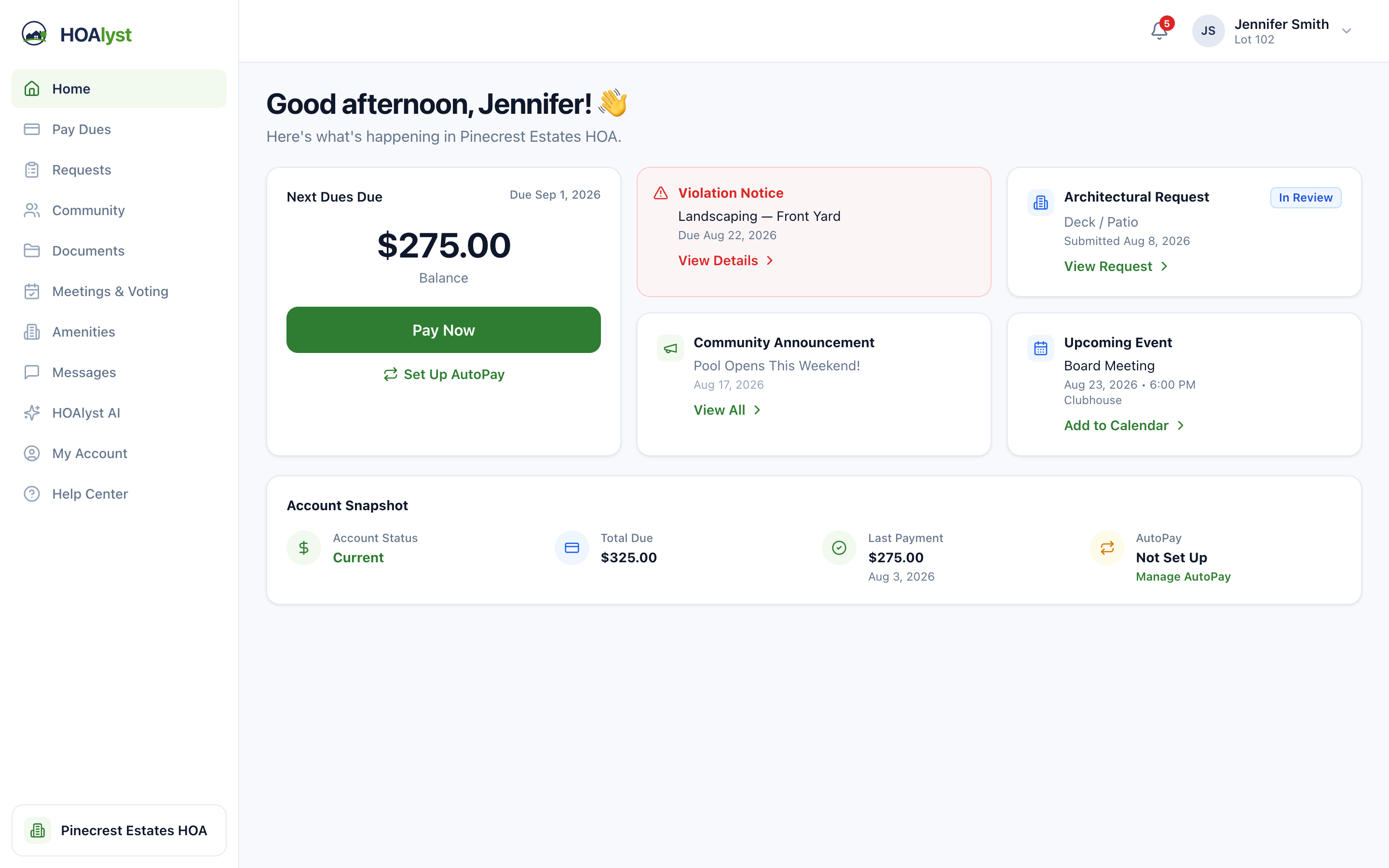
Notice is easier when the meeting and its agenda live where owners already look. In HOAlyst a board can schedule a board, annual, special or committee meeting with its agenda, owners see it and RSVP from their portal or the mobile app, and the board later publishes the minutes there for owners to read. It does not decide how much notice your association must give; your documents and your attorney do. See what boards get or try the demo with a sample association.
For the rest of the meeting, see our guides on how to run an HOA board meeting and HOA meeting minutes.
Board meeting notice checklist
- Bylaws checked for board-meeting and owner-meeting notice rules, separately.
- State statute checked, and the stricter of the two rules followed.
- Notice includes the date, time, place, type of meeting and the full agenda.
- Remote attendance details included, if the meeting allows it.
- Extra notice given for assessments, rule changes and owner meetings, where required.
- Delivered only by methods your documents and law allow, with owner consent for email where needed.
- A dated copy of the notice and proof of delivery saved with the association records.
This article is general information for community association boards, not legal advice. Laws differ by state and change over time, and your association's declaration, bylaws and rules may set different requirements. Check your governing documents, and ask your association's attorney before acting on a specific situation.