Meetings
How to Run an HOA Board Meeting, Step by Step
How to run an HOA board meeting from notice to minutes: the agenda, quorum, motions, owner comments, executive session, and what your documents require.
HOAlyst Team · · 7 min read
A good HOA board meeting is announced in advance, follows a written agenda, stays on the decisions in front of the board, and ends with those decisions recorded in the minutes. Most of what goes wrong at board meetings (a vote challenged months later, owners who feel shut out, a meeting that runs three hours) traces back to skipping one of those steps.
That matters to a lot of people. The Foundation for Community Association Research estimates there are 373,000 community associations in the U.S. with 78.1 million residents, and most of them are run by volunteer boards who were never taught how to chair a meeting. This guide walks through a board meeting from the notice to the minutes.
One caution before the steps. The rules for your meeting come from your state's law and your own governing documents: the declaration (often called the CC&Rs), the bylaws, and any rules the board has adopted. This article is general information, not legal advice. Where it quotes a state statute, it does so as an example; check what applies to your association, and ask your association's attorney before a decision that carries real risk.
Before the meeting: read what governs you
Pull out your bylaws and find the section on board meetings. It usually answers the questions boards end up arguing about: how many directors make a quorum, how much notice owners must get, whether directors may act by written consent without meeting, who chairs, and whether directors may attend by phone or video.
Then check your state's statute for homeowners or condominium associations, because it can add requirements your bylaws don't mention. Florida, for example, says board members may use email to communicate but may not cast a vote on an association matter by email (Fla. Stat. § 720.303(2)). A board that has been "voting" by reply-all would want to know that.
Write the answers down once (quorum, notice period, how owners may speak) and keep them where every director can find them. A board that has to rediscover its own rules before each meeting will eventually get one wrong.
Step 1: Write the agenda
The agenda is the meeting. An item that is not on it is hard to act on, and in some states acting on it anyway invites a challenge. A workable order for a regular board meeting:
- Call to order, and confirm that a quorum of directors is present.
- Approve the agenda and the minutes of the last meeting.
- Reports: the treasurer's report first, then committees.
- Owner comment period.
- Unfinished business carried over from the last meeting.
- New business: each item a decision the board is being asked to make.
- Date of the next meeting, and adjournment.
Write each business item as the decision, not the topic: "Approve the pool resurfacing contract with the lowest of three bids," not "Pool." It tells owners what is at stake and keeps the discussion on track. Send the board packet (financial statements, bids, committee reports) with the agenda, so directors read it before the meeting rather than during it.
Step 2: Give proper notice
Notice is the step to check most carefully, because the requirements vary so much. Two examples show the range. Florida's statute for homeowners' associations requires that notices of board meetings specifically identify the agenda items and be posted in a conspicuous place in the community at least 48 hours in advance, or mailed or delivered to each member at least 7 days before, except in an emergency. Virginia's Property Owners' Association Act requires notice of the time, date and place of each board meeting to be published where it is reasonably calculated to be available to a majority of the lot owners, and agenda materials furnished to the board to be available for members to inspect at the same time (Va. Code § 55.1-1816).
Your state may differ, and your bylaws may ask for more than the statute does. When in doubt, give more notice than the minimum, include the agenda, and keep a record of when and how the notice went out. If the meeting is ever challenged, that record is what shows it was properly called.
Step 3: Open the meeting and confirm quorum
Start on time. The chair calls the meeting to order, notes the time, and confirms a quorum of directors is present. That is usually a majority of the board, but your bylaws set the number. Without a quorum the directors can talk, but the board generally cannot act. Note who attended, including anyone joining by phone or video if your bylaws and state law allow it.
Step 4: Decide by motion
Most boards follow a simplified version of Robert's Rules of Order, or whatever procedure their bylaws name. You don't need the full rulebook to run a fair meeting. For each decision:
- A director makes a motion that states the action: "I move that we approve…"
- Another director seconds it, if your rules require a second.
- The chair opens discussion and keeps it on the motion.
- The board votes, and the chair announces the result.
Record each motion and its result. Many boards also record how each director voted on significant items; check whether your bylaws or state law require it. When a topic needs more information, the better move is usually to table it, or to ask a committee to come back with a recommendation, rather than a long debate without the facts.
Step 5: Make room for owners
Owners generally have a right to attend open board meetings, and many states give them a right to speak. Florida's statute gives members the right to speak at board meetings with reference to all designated agenda items, under reasonable written rules the association may adopt. Virginia requires a designated period during each meeting for members to comment on any matter relating to the association.
A short, predictable comment period works best: a sign-up sheet, a time limit per speaker set out in a written rule, and a chair who listens rather than debates. An owner raising a problem is not a motion. If the issue needs action, the board can put it on a future agenda and say so.
Step 6: Keep executive session to its purpose
Some topics should not be discussed in front of the whole community: advice from the association's attorney, pending or likely litigation, personnel matters, and an individual owner's delinquency or violation. Many states let a board meet privately, in executive session, for a short list of reasons like these. Virginia's statute is a clear example: the board may go into executive session only after an open vote on a motion stating the specific purpose, and no action taken in executive session becomes effective until the board reconvenes in an open meeting and votes on it.
Even where your state says less, the careful practice is the same: say in the open meeting why the board is going into executive session, discuss only that topic, and take any vote back in the open meeting. Ask your association's attorney what your state permits.
Step 7: Record and share the minutes
Minutes are a record of what the board decided, not a transcript of what everyone said. Include the date, time and place; who attended; that a quorum was present; each motion and its result; and the time the meeting adjourned. Leave out the play-by-play of a heated exchange. It rarely helps, and it can be quoted back at the board later.
Circulate a draft to the directors, approve it at the next meeting, and make it available to owners. Many states treat minutes as association records that owners may inspect; Virginia's statute, for example, requires that minutes of board meetings be recorded and made available to members.
Make the next meeting easier
Boards that run good meetings tend to share a few habits: a meeting schedule set at the start of the year, the same agenda template every time, a packet that goes out several days ahead, and minutes approved at the very next meeting. On a self-managed board it also helps to keep notices, agendas and minutes in one place, so the next board inherits a record instead of a shoebox.
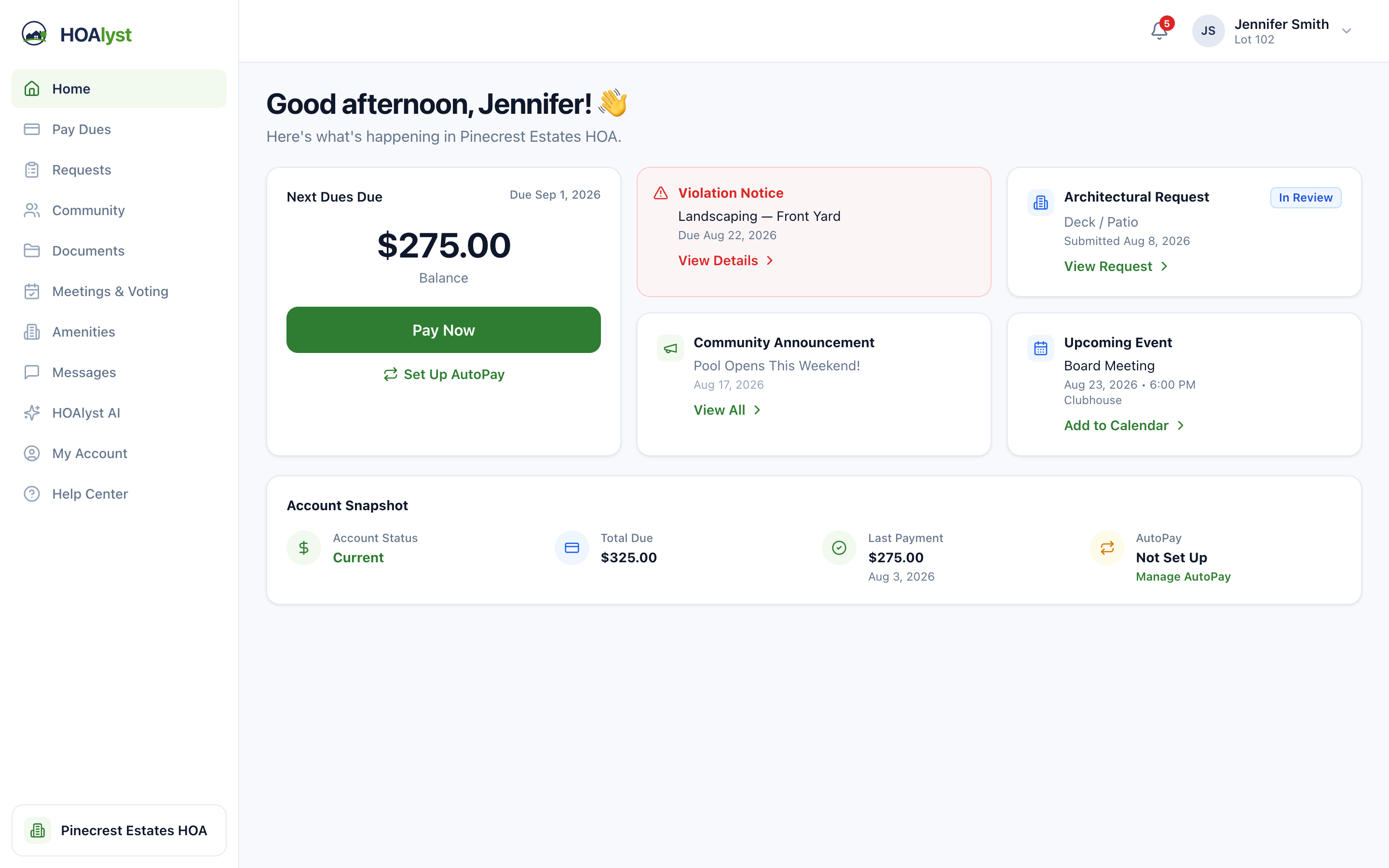
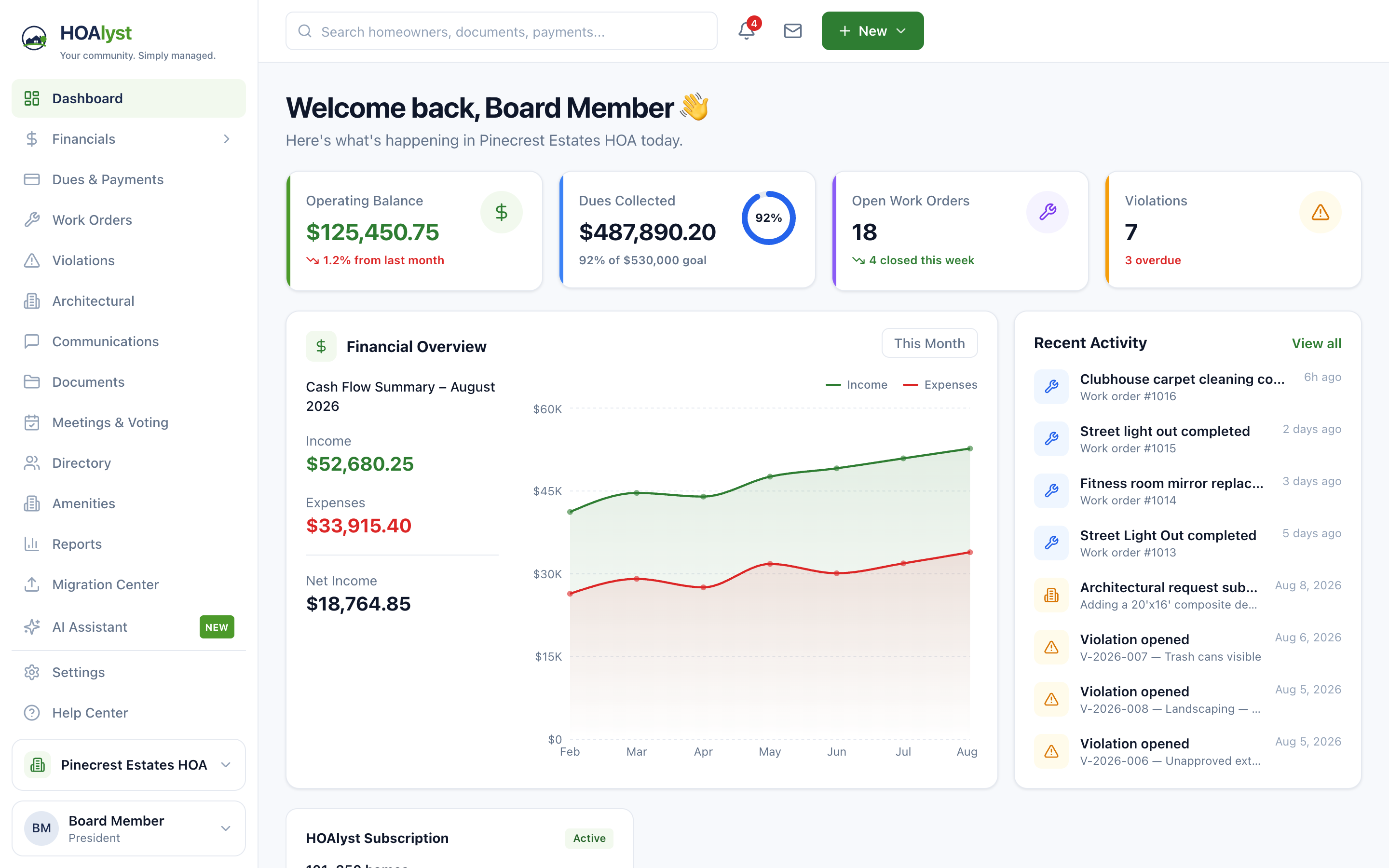
That is what HOAlyst's meetings tools are for. A board can schedule a board, annual or special meeting with its agenda, owners can RSVP from their portal, the board publishes the minutes for owners to read, and votes show how many eligible owners have voted against the quorum required. See what boards get, or try the demo to walk through a sample association.
Board meeting checklist
- Bylaws and state statute checked for quorum, notice and owner-comment rules.
- Agenda written as decisions, with the board packet attached.
- Notice given the required way, with a record of when it went out.
- Quorum confirmed and recorded at the start.
- Each motion and its result recorded.
- Executive session limited to its stated purpose, with any vote taken in open session.
- Minutes drafted, approved at the next meeting, and shared with owners.
This article is general information for community association boards, not legal advice. Laws differ by state and change over time, and your association's declaration, bylaws and rules may set different requirements. Check your governing documents, and ask your association's attorney before acting on a specific situation.