Governance
HOA Quorum Requirements for Owner and Board Meetings
What counts as a quorum at HOA owner and board meetings, where the number comes from, how proxies count, and what to do when not enough owners show up.
HOAlyst Team · · 7 min read
An HOA quorum is the minimum number of people who must be present, in person or by an allowed substitute such as a proxy, before a meeting can do binding business. There are two different quorums to track: one for meetings of the owners (annual meetings, special meetings, elections) and one for meetings of the board. The owner quorum is usually set as a percentage of the association's total voting interests, and the board quorum is usually a majority of the directors. Your bylaws normally set both numbers, and your state's statute fills in a default or a limit when the bylaws do not.
This matters to a lot of people. The Foundation for Community Association Research estimates there are 373,000 community associations in the U.S., and every one of them has to reach a quorum before its members or its board can act.
This article is general information, not legal advice. The rules for your association come from your state's law and your governing documents (the declaration or CC&Rs, the articles of incorporation, the bylaws and any rules the board has adopted), and they vary widely. Where we quote a statute, it is an example, not a statement of what applies to you. Ask your association's attorney before relying on any of this for a real decision.
Where your quorum number comes from
Start with the bylaws. Look for a section titled "quorum" under member meetings and another under board meetings. The articles of incorporation sometimes set or change the number too, and the declaration may require a particular share of owners for certain votes, such as amending the declaration itself.
Then check your state law. Most associations are nonprofit corporations, so two statutes can apply: the state law for homeowners or condominium associations, and the state nonprofit corporation act. The association statute usually controls where it speaks to the question. Where it is silent, the nonprofit act often supplies the default.
A quorum requirement is about attendance, not about how a vote comes out. Once a quorum is present, a separate rule decides how many votes it takes to pass a motion. Keep the two apart; mixing them up is one of the most common sources of confusion at owner meetings.
Quorum at owner meetings
State defaults differ, and some are lower than boards expect. In Florida homeowners' associations, unless the bylaws set a lower number, the quorum at a meeting of the members is 30 percent of the total voting interests, and unless the law or the governing documents say otherwise, a decision needs a majority of the voting interests present, in person or by proxy, at a meeting where a quorum has been reached (Fla. Stat. § 720.306(1)(a)).
Florida condominiums start from a higher default. Under the condominium act, unless the bylaws provide a lower number, the quorum at a meeting of the unit owners is a majority of the voting interests, and decisions are made by a majority of the voting interests represented at a meeting where a quorum is present, unless the law or the documents provide otherwise (Fla. Stat. § 718.112(2)(b)1).
Notice that both examples let the bylaws set a lower number. That is common, and many associations have used it because owner turnout is hard to predict. Read your bylaws before assuming your state default applies.
How proxies and ballots count
Owners who cannot attend can often still count toward a quorum. Florida's homeowners' association statute gives members the right, unless the statute or the governing documents provide otherwise, to vote in person or by proxy, and says a valid proxy must be dated, name the date, time and place of the meeting, be signed, and lasts only for that meeting and its lawful adjournments, expiring 90 days after the original meeting date (Fla. Stat. § 720.306(8)(a)). Florida's condominium act says limited proxies and general proxies may be used to establish a quorum, while limiting general proxies for many votes (Fla. Stat. § 718.112(2)(b)2).
Absentee ballots, mailed ballots and electronic voting may or may not count toward a quorum, depending on your state and your documents. Some states treat a returned ballot as participation for quorum purposes and some do not. If your association plans to rely on them, confirm the rule with your attorney before the meeting rather than after.
Quorum at board meetings
For the board, the usual default is a majority of the directors. Florida's nonprofit corporation act, for example, says that unless the articles or bylaws require a different number, a quorum of a board of directors consists of a majority of the number of directors prescribed by the articles or bylaws, and that the articles may allow a smaller quorum of no fewer than one-third. When a quorum is present at the vote, the act of the board is the affirmative vote of a majority of the directors present, unless the articles or bylaws require more (Fla. Stat. § 617.0824(1)-(3)).
So on a five-member board, three directors are usually a quorum, and two of those three voting yes can pass an ordinary motion. A vacancy does not normally lower the number unless your documents say it does, so check how they count a board with an empty seat.
Remote participation can count. Florida's condominium act says a board or committee member's participation by telephone, real-time videoconferencing, or similar real-time electronic or video communication counts toward a quorum, and that a written agreement or disagreement from a member who did not attend may not be used to create a quorum (Fla. Stat. § 718.112(2)(b)4-5). Your state may have a different rule, so do not assume a phone call counts without checking.
When a quorum turns a gathering into a meeting
Quorum also decides when open-meeting rules apply. In Florida homeowners' associations, a meeting of the board occurs whenever a quorum of the board gathers to conduct association business, and board meetings must be open to all members, with a narrow exception for certain meetings with the association's attorney (Fla. Stat. § 720.303(2)(a)). Florida's condominium act likewise says board meetings at which a quorum of the members is present are open to all unit owners (Fla. Stat. § 718.112(2)(c)).
The practical point: when enough directors to make a quorum get together, even informally, and talk through association business, many states treat that as a board meeting that needed notice and should have been open to owners. Decisions belong at noticed meetings. Our guide to board meeting notice requirements covers what that notice has to say.
What to do when you do not reach a quorum
An owner meeting without a quorum generally cannot take binding votes. Typical options, depending on your documents and state law:
- Adjourn the meeting to a new date, time or place, as your bylaws and statute allow.
- Hold an informational session with the owners who came, with no votes taken.
- Check whether your bylaws allow a lower quorum at a reconvened meeting; some do.
- Use the time before the reconvened meeting to collect proxies or ballots, where they are allowed.
- Ask your attorney about other routes, such as action by written consent, if your documents and statute permit it.
If you adjourn, follow the notice rule for it. In Florida homeowners' associations, unless the bylaws require otherwise, the new date, time or place of an adjourned annual or special meeting must be announced at that meeting before an adjournment is taken, or notice must be given under the board meeting notice rules, and any business that could have been done at the original meeting can be done at the adjourned one (Fla. Stat. § 720.306(7)).
Elections can be a special case. Florida's homeowners' association statute says that when there are no more qualified candidates than open seats and floor nominations are not required, the candidates commence service on the board of directors, regardless of whether a quorum is attained at the annual meeting (Fla. Stat. § 720.306(9)(a)). Not every state has a rule like that, so do not rely on it elsewhere.
Ways to make quorum easier to reach
- Know the exact number before the meeting: total voting interests times the quorum percentage, rounded the way your documents require.
- Track RSVPs and proxies in the days before, so you know whether to push for more.
- Send reminders, and tell owners plainly why their attendance or proxy matters.
- Offer remote attendance or electronic voting where your state and documents allow it.
- Hold the meeting at a time and place that suits working owners.
- Count attendance at the start, record it in the minutes, and recount if people leave before a vote.
Recording the quorum is part of the job. The minutes should state that a quorum was present and how it was determined. Our guide to HOA meeting minutes shows where that goes.
Where HOAlyst fits
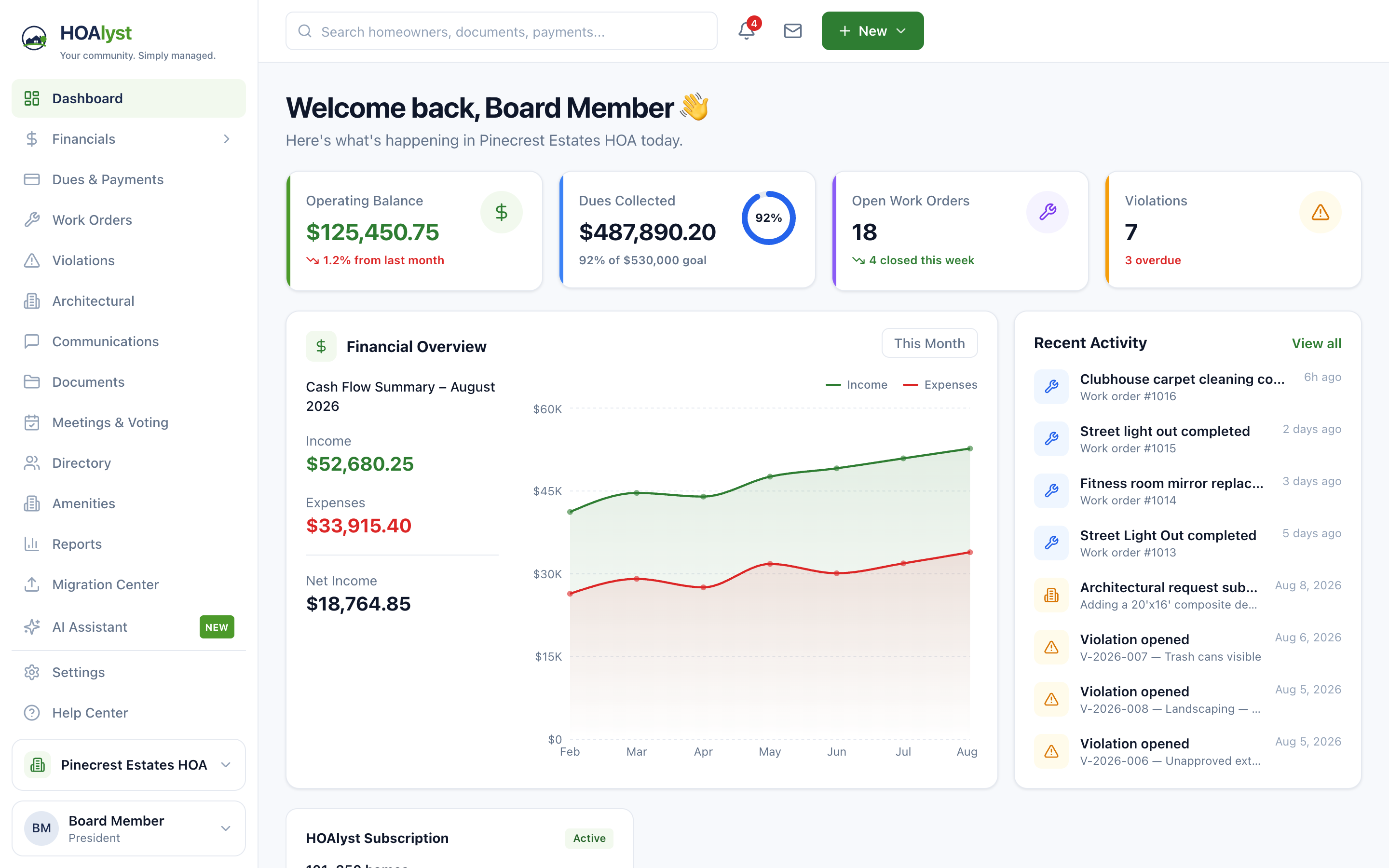
Counting is easier when the numbers are already in front of you. In HOAlyst a board records its quorum percentage in settings, sets the quorum required for a meeting, and runs electronic votes that show how many eligible members have voted against the quorum needed, with a clear flag while quorum is not yet met. Owners RSVP to meetings and vote from their portal or the mobile app. It does not decide what your quorum is; your documents and your attorney do. See what boards get or try the demo with a sample association.
For the meeting itself, see how to run an HOA board meeting.
Quorum checklist
- Owner-meeting quorum found in the bylaws, with the state default checked.
- Board quorum found in the bylaws or articles, with the state default checked.
- Rules for proxies, absentee ballots and electronic votes confirmed, including whether they count toward quorum.
- Rules for remote attendance by directors and owners confirmed.
- The exact number needed worked out before the meeting.
- Attendance counted at the start and before each vote, and recorded in the minutes.
- An adjournment plan ready, with the notice rule for reconvening, in case quorum is not reached.
This article is general information for community association boards, not legal advice. Laws differ by state and change over time, and your association's declaration, bylaws and rules may set different requirements. Check your governing documents, and ask your association's attorney before acting on a specific situation.