Governance
HOA Online Voting: Rules, Consent and Secret Ballots
Can your HOA vote online? What state laws require, owner consent, secret ballots, quorum, and steps for running your first online vote.
HOAlyst Team · · 7 min read
Yes, many HOAs and condo associations can hold elections and other owner votes online, but only in the way their state law and governing documents allow. Some states have a specific electronic voting statute with conditions such as owner consent, identity checks, a receipt for each vote and, for secret-ballot elections, a system that cannot link a ballot to the voter. Other states allow votes "by electronic means" unless the declaration prohibits it. Where neither the law nor the documents address it, the board usually needs to amend the bylaws or adopt a procedure first. The steps below walk through what to check and how to run a first online vote.
Getting this right matters for a lot of people. The Foundation for Community Association Research estimates there are 373,000 community associations in the U.S., and many of them struggle to reach quorum with paper ballots and in-person meetings alone.
This article is general information, not legal advice. Your state's law and your association's governing documents (the declaration or CC&Rs, the articles of incorporation, the bylaws and any adopted rules) control, and they vary a great deal. Where we quote a statute, it is an example from one state, not a statement of what applies to you. Ask your association's attorney before relying on any of this for a real election.
What counts as HOA online voting?
People use "online voting" and "electronic voting" for several different things, and the law often treats them differently:
- Owners casting ballots through a website or app built for association votes.
- Owners emailing a completed ballot to the association.
- Owners voting during a meeting held by video or phone.
- Directors voting among themselves by email between board meetings.
This article is mostly about the first: owners voting through an online system on elections, budgets, amendments and other matters the membership decides. The last item, directors deciding by email, is a separate question with its own limits, covered further down.
Start with your governing documents
Before looking at any software, read three things. First, the bylaws: how elections are held, whether ballots must be secret, whether voting by mail or absentee ballot is allowed, how many votes each lot or unit has, and what counts toward quorum. Second, the declaration: some declarations require a written, signed ballot or an in-person vote for certain matters, such as amendments. Third, any election rules or procedures the board has adopted. If those documents are silent or require paper, your state law may still allow electronic voting, or the board may need to adopt a resolution or ask owners to amend the bylaws.
Example: states with a specific online voting statute
Florida has detailed rules for both homeowners' associations and condominiums. Its HOA statute lets an association conduct elections and other membership votes through an Internet-based online voting system if a member consents, electronically or in writing, and the association and the system meet a list of requirements (Fla. Stat. § 720.317). Among them, the association must give each member a way to authenticate their identity and a way to confirm, at least 14 days before the voting deadline, that their device can communicate with the system. The system must be able to authenticate the member, confirm each vote was not altered in transit, send each voter a receipt, and store ballots so election officials can recount and review them.
The Florida HOA statute also addresses secret ballots and quorum. If the bylaws provide for secret ballots in director elections, the system must be able to permanently separate identifying information from the ballot. A member who votes electronically is counted as attending the meeting for quorum. The statute applies only once the board authorizes online voting by resolution, and the resolution must give members notice of the opportunity, set procedures and deadlines for consenting, and set procedures for opting out. Notice of the meeting where the board will consider that resolution must go to owners and be posted at least 14 days before the meeting (Fla. Stat. § 720.317(3)).
Florida condominiums follow a similar section, with a few differences. For board elections, the system must keep each ballot secret, and a substantive vote may not be taken on any issue other than the ones identified in the electronic vote when quorum is established by electronic voters (Fla. Stat. § 718.128). If at least 25 percent of the voting interests petition the board to adopt electronic voting for the next election, the board must hold a meeting within 21 days to adopt such a resolution (Fla. Stat. § 718.128(6)). The same section also sets out a separate email-ballot method with its own required warning that emailing a ballot waives its secrecy.
Example: states that allow "electronic means" generally
Other states take a broader approach. Virginia's Property Owners' Association Act says that, unless the declaration expressly prohibits it, any vote, consent or approval required under the declaration, the bylaws or the statute may be accomplished using electronic means (Va. Code § 55.1-1832(A)). It adds two conditions worth copying even if your state is silent: a record must be created as evidence of the vote and kept as long as a paper record would be, and if the vote must be by secret ballot, the electronic method must protect the voter's identity; if it cannot, another way of voting must be used (Va. Code § 55.1-1832(D)).
Many states have no HOA-specific rule at all. In that case, your nonprofit corporation statute and your bylaws usually decide, and your attorney can tell you whether an online ballot is allowed or whether the bylaws should be amended first.
Consent, notice and the owners who stay on paper
Even where online voting is allowed, assume some owners will not use it. A fair process keeps a paper or in-person option for anyone who wants one, and tells every owner clearly how to vote both ways. Where your state requires owner consent, keep a dated record of who consented and who opted out, and do not count an online ballot from someone who has not consented. Send the election notice the same way you always would under your bylaws and state law; announcing a vote only through an app can leave out owners who have not signed in.
Our guide to HOA board meeting notice requirements and our HOA annual meeting requirements cover the notice side in more detail.
Quorum and online ballots
One of the main reasons boards move votes online is quorum. Whether an online ballot counts toward quorum is set by your state and documents. Florida, as noted above, counts an electronic voter as present for quorum. Where the law is silent, check whether your bylaws count absentee or mail ballots toward quorum, since online ballots are often treated the same way. Our HOA quorum requirements guide explains how to find your number and what to do when a meeting falls short.
Secret ballots
If your bylaws or state law require secret ballots for director elections, an ordinary online form that records who voted for whom is not enough. Look for a method that separates the voter from the ballot, or use a secret paper ballot for that election and online voting for matters where secrecy is not required. When you are unsure, ask your attorney before the election, not after a candidate challenges the result.
Board members voting by email
Directors deciding things by email between meetings is a different issue from owners voting online. Some states limit it sharply. Florida's HOA statute, for example, allows directors to use email to communicate but says they may not cast a vote on an association matter via e-mail (Fla. Stat. § 720.303(2)(a)). Other states and bylaws allow unanimous written consent without a meeting. Check both before a board relies on an email thread to make a decision.
How to run your first online vote
- Read the bylaws, declaration and any election rules for voting method, secrecy, eligibility and quorum.
- Check your state law, and ask your attorney whether a board resolution, owner consent or a bylaw amendment is needed first.
- Decide which matters will be voted online and whether any (such as secret-ballot elections) will stay on paper.
- Confirm the list of eligible voters and how many votes each lot or unit has, as of a set date.
- Send notice by the methods your documents require, with clear instructions for both online and paper voting.
- Set an opening and closing time and keep it; do not extend a vote after seeing early results.
- After it closes, record the count, whether quorum was met and the result in the minutes, and keep the ballots and voter records as long as your documents and state law require.
Where HOAlyst fits
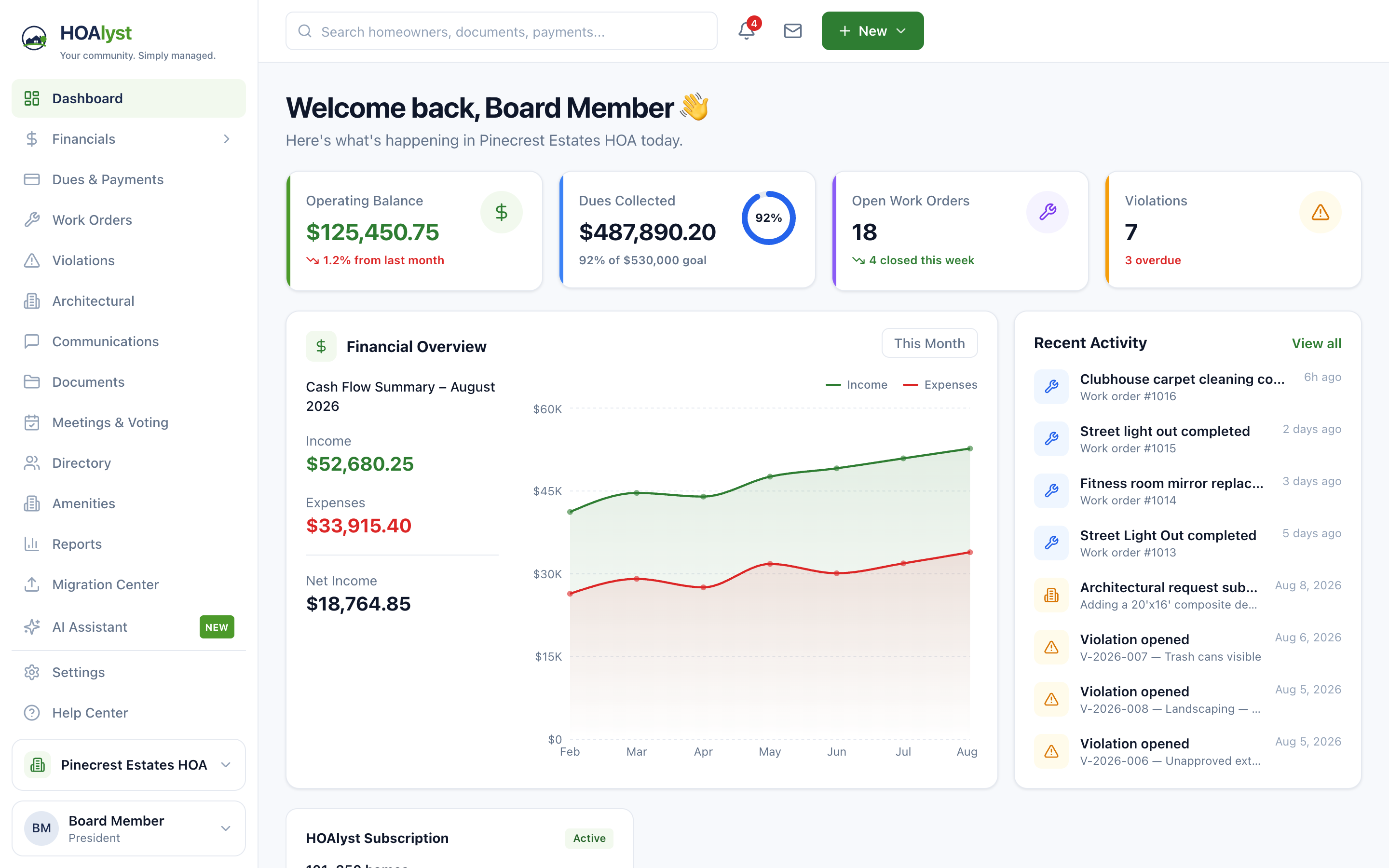
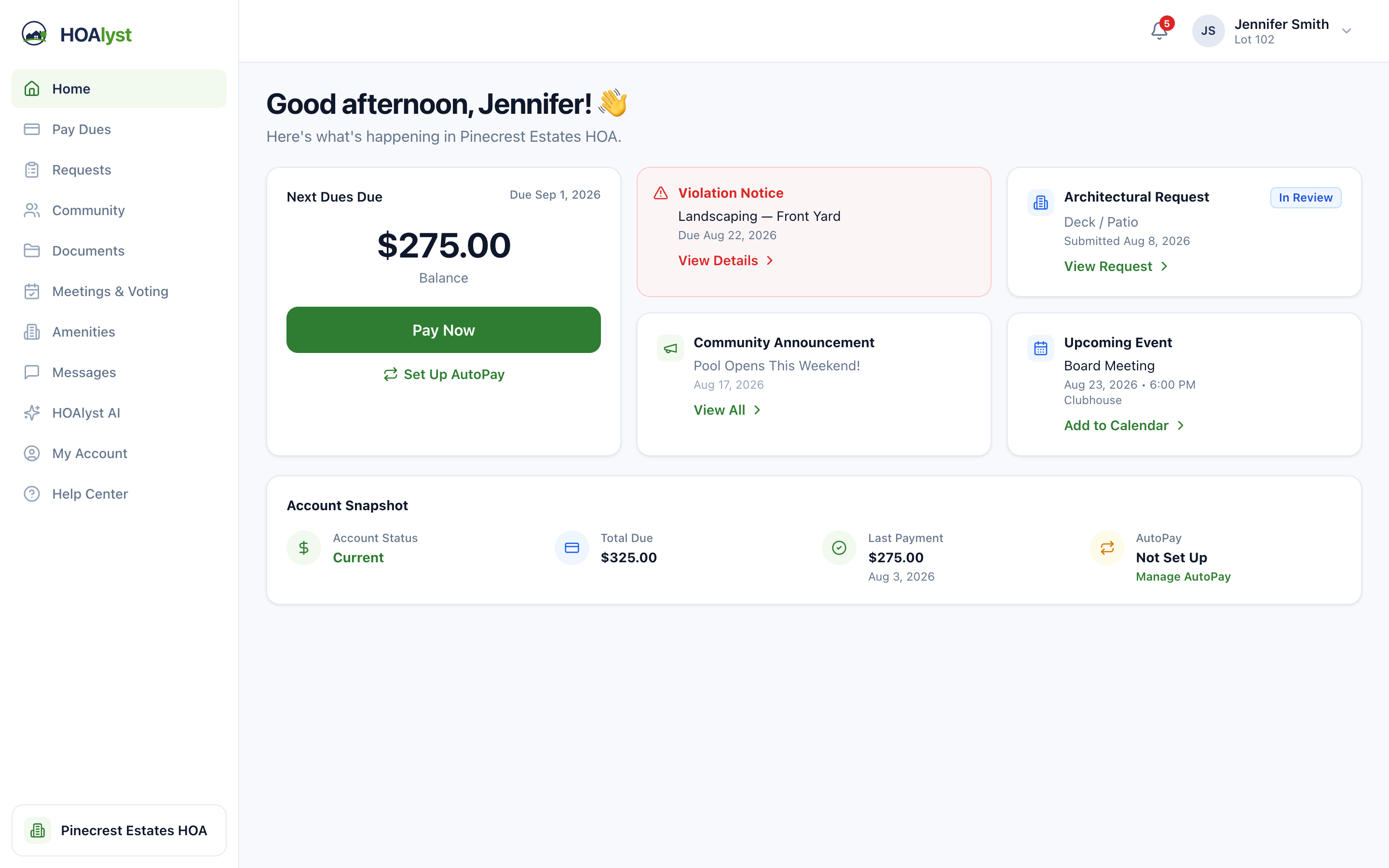
In HOAlyst, a board can open a vote with a set opening and closing time, attach it to a meeting, and choose a simple majority, supermajority or unanimous threshold. Owners cast their ballot in the owner portal or the mobile app, each member or unit votes once, and a ballot cannot be changed after it is cast. The list of eligible voters is fixed when the vote opens, and the result shows whether quorum was met before it is certified. Ballots are tied to the voter's account, so if your bylaws require a secret ballot for an election, check with your attorney before using it for that vote. See what boards get or try the demo with a sample association.
Online voting checklist
- Governing documents read for voting method, secrecy and quorum.
- State law checked, and any required resolution, consent or amendment in place.
- Paper or in-person option kept for owners who want it.
- Eligible voters and vote counts confirmed as of a set date.
- Notice sent by the methods your documents require.
- Fixed opening and closing times.
- Results, quorum and the count recorded in the minutes, and ballots kept.
This article is general information for community association boards, not legal advice. Laws differ by state and change over time, and your association's declaration, bylaws and rules may set different requirements. Check your governing documents, and ask your association's attorney before acting on a specific situation.