Governance
HOA Executive Session Rules: What Boards Can Discuss
When can an HOA board meet in executive session? The topics that qualify, how to go into one, what the minutes say, and why votes belong in open session.
HOAlyst Team · · 8 min read
An HOA executive session is the part of a board meeting that owners do not attend. Most associations may hold one only for a short list of sensitive topics: talking with the association's attorney about litigation, personnel matters, and, in some states, contracts being negotiated, violation cases and an individual owner's delinquency. The usual rules are simple to state: the topic must be one your state law or governing documents allow, the board should say why it is going into closed session, discussion stays on that topic, and any final decision is voted on in open session and recorded in the minutes.
Those rules matter because so many people live under them. The Foundation for Community Association Research estimates there are 373,000 community associations in the U.S., and most of their boards meet in open session by default.
This article is general information, not legal advice. Your state's law and your association's governing documents (the declaration or CC&Rs, the articles of incorporation, the bylaws and any adopted rules) control, and they vary a great deal. Where we quote a statute, it is an example from one state, not a statement of what applies to you. Ask your association's attorney before relying on any of this for a real decision.
What is an HOA executive session?
Board meetings in most community associations are open to the owners. An executive session (some documents call it a closed session) is an exception to that rule: the board, and anyone it invites such as its attorney or manager, meets without the members present. It is usually held as a portion of a regular board meeting, either at the start or the end, rather than as a separate secret meeting.
The exception is narrow on purpose. Owners pay the assessments and live with the decisions, so state laws that address the question generally start from openness and list the few things a board may discuss privately. An executive session is not a way to have the real debate out of view and then rubber-stamp it in public.
Can owners attend an executive session?
Usually not. That is what makes it an executive session: owners may attend the open part of the meeting, then step out while the board discusses the closed topic, and come back for any vote. The board may invite people it needs, such as its attorney, manager or an owner whose own violation case or delinquent account is being discussed. Committees can hold executive sessions too, where state law and the documents allow it.
Topics that usually qualify
States draw the list differently. Florida's homeowners' association statute says board meetings must be open to all members, except for meetings between the board and its attorney about proposed or pending litigation where the discussion would otherwise be covered by attorney-client privilege (Fla. Stat. § 720.303(2)(a)). The same subsection adds that meetings with the association's attorney to discuss proposed or pending litigation, and board meetings held to discuss personnel matters, are not required to be open to members other than directors (Fla. Stat. § 720.303(2)(b)).
Florida condominiums have a parallel rule. The open-meeting requirement does not apply to meetings between the board or a committee and the association's attorney about proposed or pending litigation, if the meeting is held for the purpose of seeking or rendering legal advice, or to board meetings held to discuss personnel matters (Fla. Stat. § 718.112(2)(c)5).
Virginia's list is longer. Under its Property Owners' Association Act, the board or a board committee may go into executive session to consider personnel matters; consult with legal counsel; discuss and consider contracts, pending or probable litigation, and matters involving violations of the declaration or rules; or discuss and consider the personal liability of members to the association (Va. Code § 55.1-1816(C)). Virginia's Condominium Act gives condo boards a similar list (Va. Code § 55.1-1949(C)).
Taken together, the topics that most often qualify are:
- Advice from the association's attorney, especially about a lawsuit that is threatened or underway.
- Personnel matters, such as the performance or discipline of an employee.
- Contracts while they are being negotiated, where your state allows it.
- Violation cases and hearings about a specific owner, where your state allows it.
- An individual owner's delinquent account or other personal liability to the association, where your state allows it.
Topics that usually do not qualify include the budget, assessment increases, rule changes, choosing a vendor once the contract is no longer being negotiated, and general disagreements among directors. If a topic is not on the list your state and documents allow, the safe assumption is that it belongs in open session.
How to go into executive session
Some states spell out the procedure. Virginia's property owners' association statute, for example, allows an executive session only upon the affirmative vote in an open meeting to assemble in executive session; the motion must state specifically the purpose for the session, the minutes must include a reference to the motion and its stated purpose, and the board must limit its discussion to the purposes stated in the motion (Va. Code § 55.1-1816(C)).
Even where your state is silent, that sequence is a sensible habit:
- List the executive session on the meeting agenda, with the general topic (for example, "legal advice regarding pending litigation"), not the confidential details.
- In open session, a director moves to go into executive session and states the purpose. The board votes on the motion.
- Owners who are attending step out, or the online meeting moves to a separate session. Keep the attorney, manager or others only if they are needed for that topic.
- Discuss only the stated topic. If something else comes up, save it for open session.
- Return to open session and say on the record that the executive session has ended.
Our HOA board meeting agenda template shows where an executive session line fits, and our guide to HOA board meeting notice requirements covers posting the agenda in time.
Votes happen in open session
The rule boards most often miss is that a decision reached in closed session may not count until it is voted on in public. Virginia's property owners' association statute says no contract, motion or other action adopted in executive session shall become effective unless the board, following the executive session, reconvenes in open meeting and takes a vote on it, with its substance reasonably identified in the open meeting (Va. Code § 55.1-1816(C)).
Even where the law does not say so expressly, voting in open session protects the board. It gives owners a record of what was decided, shows that a quorum of the board acted, and avoids later claims that the decision was made improperly. "Reasonably identified" does not mean disclosing privileged details. A motion such as "to approve the settlement agreement discussed in executive session, on the terms presented by counsel" or "to authorize the attorney to file suit to collect the delinquent account for the lot discussed" usually tells owners what happened without revealing confidential strategy. Ask your attorney how to word motions about litigation.
What goes in the minutes
Minutes of the open meeting should record that the board went into executive session, the motion and the stated purpose, the time it went in and came out, and any vote taken in open session afterward. Detailed notes of what was said in the closed portion are often not kept, or are kept separately and treated as confidential, especially when the discussion was with the attorney. Whether those notes are a record owners can inspect depends on your state and documents.
Florida's homeowners' association statute, for example, lists minutes of all meetings among the official records, and it also lists records an association may withhold from inspection, including records protected by the lawyer-client privilege and certain personnel records (Fla. Stat. § 720.303(4) and (5)(g)). Ask your attorney before releasing anything from an executive session. Our guide to HOA meeting minutes covers the open-session minutes in more detail.
Keeping executive session confidential
Directors owe duties to the association, and that usually includes keeping privileged and personal information private. Talking about an attorney's litigation advice with neighbors can weaken the association's position, and sharing an owner's delinquency or a staff member's discipline can create its own problems. A few practical habits help:
- Keep executive session materials out of the general agenda packet that owners can inspect.
- Store confidential documents where only directors can open them.
- Do not forward privileged emails from the attorney to anyone outside the board.
- When a director leaves the board, make sure confidential materials stay with the association.
Virginia's statutes, for example, require that agenda packets and materials furnished to the board be made available for inspection by the membership at the same time they go to directors, unless they relate to an executive session (Va. Code § 55.1-1816(B)). That exception is a good reason to keep executive session materials in their own folder.
Common mistakes
- Going into closed session for a topic that is not on the allowed list, such as the budget or a rule change.
- Skipping the motion and the stated purpose, so the minutes never show why the board met privately.
- Letting the discussion drift to other business once the owners have left.
- Reaching a decision in closed session and treating it as final without an open vote.
- Using email or a group chat among a quorum of directors to decide things between meetings. Florida, for example, lets directors use email to communicate but says they may not cast a vote on an association matter via e-mail (Fla. Stat. § 720.303(2)(a)).
Where HOAlyst fits
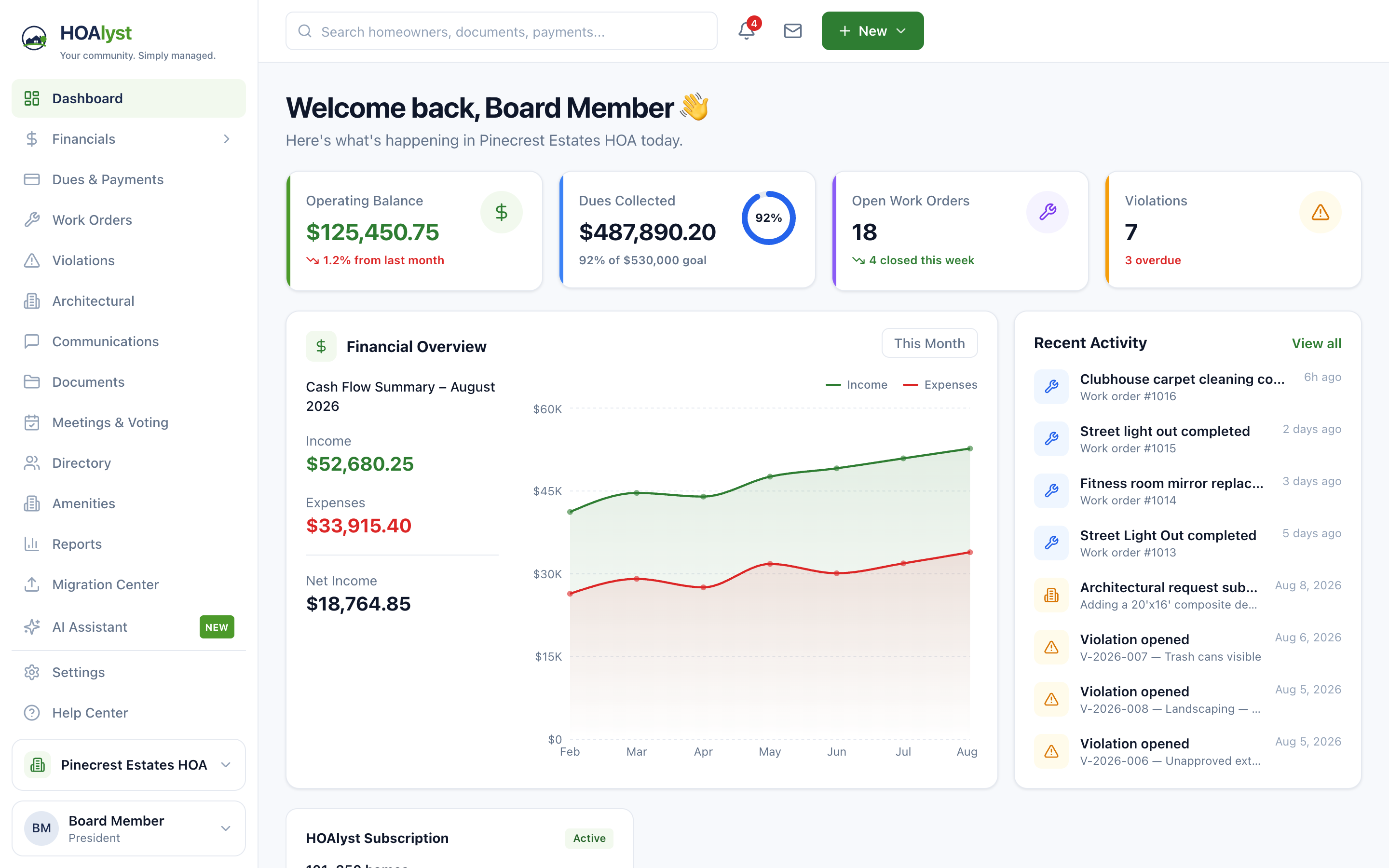
In HOAlyst a board builds each meeting with an agenda, so the executive session can sit on it as its own item, and after the meeting the board publishes the minutes for owners to read in the portal. Documents can be marked "Board only", so the attorney's letter or a personnel file stays visible to directors and out of the owner portal. It does not decide which topics may be discussed privately; your documents, state law and your attorney do. See what boards get or try the demo with a sample association.
Executive session checklist
- State law and bylaws read for the topics allowed in closed session.
- Executive session listed on the agenda with a general topic.
- Motion made and voted on in open session, stating the purpose.
- Discussion kept to the stated purpose.
- Any decision voted on after returning to open session, with its substance identified.
- Minutes record the motion, the purpose and the open vote.
- Confidential materials stored where only directors can see them.
This article is general information for community association boards, not legal advice. Laws differ by state and change over time, and your association's declaration, bylaws and rules may set different requirements. Check your governing documents, and ask your association's attorney before acting on a specific situation.