Dues
HOA Late Fees: Rules, Limits and a Sample Policy
Can an HOA charge late fees? Where the authority comes from, state limits, grace periods, late fees vs. fines and interest, and a sample policy for boards.
HOAlyst Team · · 8 min read
Yes, an HOA can usually charge late fees on unpaid dues, but only if its governing documents authorize them, only in the amount those documents (or a board resolution they allow) set, and only within any limit state law imposes. A late fee is an administrative charge for paying an assessment after its due date and grace period. It is not a fine for breaking a rule, and it is not the same as interest. Below is where the authority comes from, how states limit it, how to set up a fair policy, and a sample policy a board can adapt.
Late payments are a routine part of running any association. The Foundation for Community Association Research estimates there are 373,000 community associations in the U.S., and nearly all of them rely on assessments as their main source of money. A clear, consistently applied late fee policy keeps the budget whole without turning every late payment into a dispute.
This article is general information, not legal advice. Your association's governing documents (the declaration or CC&Rs, the bylaws and any adopted collection policy) and your state's law control whether you may charge a late fee, how much, and when. Where we quote a statute, it is an example from one state. Ask your association's attorney before adopting or changing a late fee or starting any collection action.
Where the authority to charge a late fee comes from
An association can only charge what its documents and the law allow. Look in this order:
- The declaration (CC&Rs). Most declarations say assessments are due on a set date and that late payments may carry a late charge, interest and collection costs. Some state the amount; others let the board set it.
- The bylaws. They often describe the board's power to set and collect assessments and to adopt rules, including a collection policy.
- A board resolution or collection policy. Where the declaration lets the board set the late fee, the board adopts the amount and grace period by a vote at a properly noticed meeting and records it in the minutes.
- State law. Some states cap late fees, set the order in which payments are applied, or require notice before collection costs can be added.
If none of these authorizes a late fee, the association generally should not charge one. A late fee that was never properly adopted is one of the easiest charges for an owner to challenge.
Example: Florida limits
Florida is a useful example because its statutes spell the rules out. For homeowners' associations, unpaid assessments and installments bear interest at the rate in the declaration or bylaws, or simple interest at 18 percent per year if no rate is provided, and compound interest may not accrue. If the declaration or bylaws so provide, the association may also charge an administrative late fee not to exceed the greater of $25 or 5 percent of each installment paid past the due date (Fla. Stat. § 720.3085(3)(a)).
Florida condominiums have a parallel rule: if the declaration or bylaws provide for it, the association may charge, in addition to interest, an administrative late fee of up to the greater of $25 or 5 percent of each delinquent installment (Fla. Stat. § 718.116(3)). Both statutes also set the order in which a payment is applied: first to interest, then to the late fee, then to collection costs and attorney fees, and only then to the delinquent assessment.
Other states take different approaches. Some cap the dollar amount or percentage, some only require that the fee be reasonable, and many leave it entirely to the governing documents. Check your own state's statute rather than assuming another state's limit applies.
Late fees, interest and fines are different charges
Owners and boards often mix these up, and the difference matters:
- A late fee is a one-time administrative charge for paying an assessment late, usually a flat amount or a percentage of the late installment.
- Interest accrues over time on the unpaid balance at the rate your documents or state law allow.
- A fine is a penalty for violating a rule, and in many states it requires notice and a chance to be heard before it is imposed.
Florida's homeowners' association statute says outright that a late fee is not a fine (Fla. Stat. § 720.3085(3)(b)). That distinction is why a board can charge a late fee on an overdue assessment without holding a hearing, but cannot fine an owner for a violation without following the fine process. Our guide to the HOA fine hearing covers that process.
Can an HOA charge late fees on fines?
This is one of the most searched questions about late fees, and the answer depends on how your documents and state law treat fines. Some declarations make fines collectible like assessments, which may let late charges apply; others do not, and some state laws limit how fines can be collected. Because the rules vary so much, a board should not add late fees to unpaid fines unless its documents clearly allow it and its attorney agrees.
Grace periods and due dates
A grace period is the time after the due date before a late fee applies. Many declarations set one; where they do not, boards commonly adopt one in the collection policy. A grace period does three useful things: it absorbs mail and bank delays, it avoids charging owners whose payment was simply in transit, and it makes the policy easier to defend as reasonable.
Whatever you choose, write it down and apply it to every owner the same way. Decide in advance how the policy handles a payment that is returned by the bank after it was received on time, a special assessment paid in installments, and an owner on an approved payment plan. Our guide to HOA special assessment rules covers installment plans.
Notice before collection
Late fees are usually the first step in a collection policy, not the last. Before an association escalates, many states require a written notice that gives the owner a chance to pay. In Florida homeowners' associations, the association may not require payment of attorney fees related to a past-due assessment without first delivering a written notice of late assessment that states the amount owed and gives the owner 30 days to pay it without attorney fees (Fla. Stat. § 720.3085(3)(d)). The statute prescribes the form of that notice and how it must be mailed.
Even where no statute requires it, a short, polite reminder after the grace period and a written notice before any collection costs are added resolve most late payments. The tone of our HOA violation letter template works for payment reminders too: state the facts, the amount, the deadline and how to pay.
Waiving a late fee
Boards are often asked to waive a late fee for a first-time late payment, a hardship or a bank error. Many boards allow it, but the risk is inconsistency: waiving for one owner and not another invites complaints of favoritism. If your board waives fees, adopt a written rule for when it will (for example, a first late payment in a set period, or a documented bank or association error), apply it to everyone, and record each waiver.
Sample HOA late fee policy
Adapt this to your documents and have your attorney review it before the board adopts it. Fill in the blanks from your declaration or the board's resolution.
- Assessments are due on the ____ of each ____ (month, quarter or year).
- A payment not received within ____ days after the due date is late.
- A late fee of $____ (or ____ of the late installment), as authorized by Article ____ of the declaration, is charged once per late installment.
- Interest accrues on unpaid assessments at the rate stated in the declaration, as permitted by state law.
- Payments are applied in the order required by state law or, if none, by the declaration.
- A reminder is sent after the grace period; a written notice of late assessment is sent before any collection costs or attorney fees are added.
- A payment returned by the bank is treated as unpaid from ____ (the original due date, or the date of return).
- The board may waive a late fee only under this written rule: ____, and records each waiver.
- Owners may request a payment plan by contacting the board or manager before the account is referred to collections.
Where HOAlyst fits
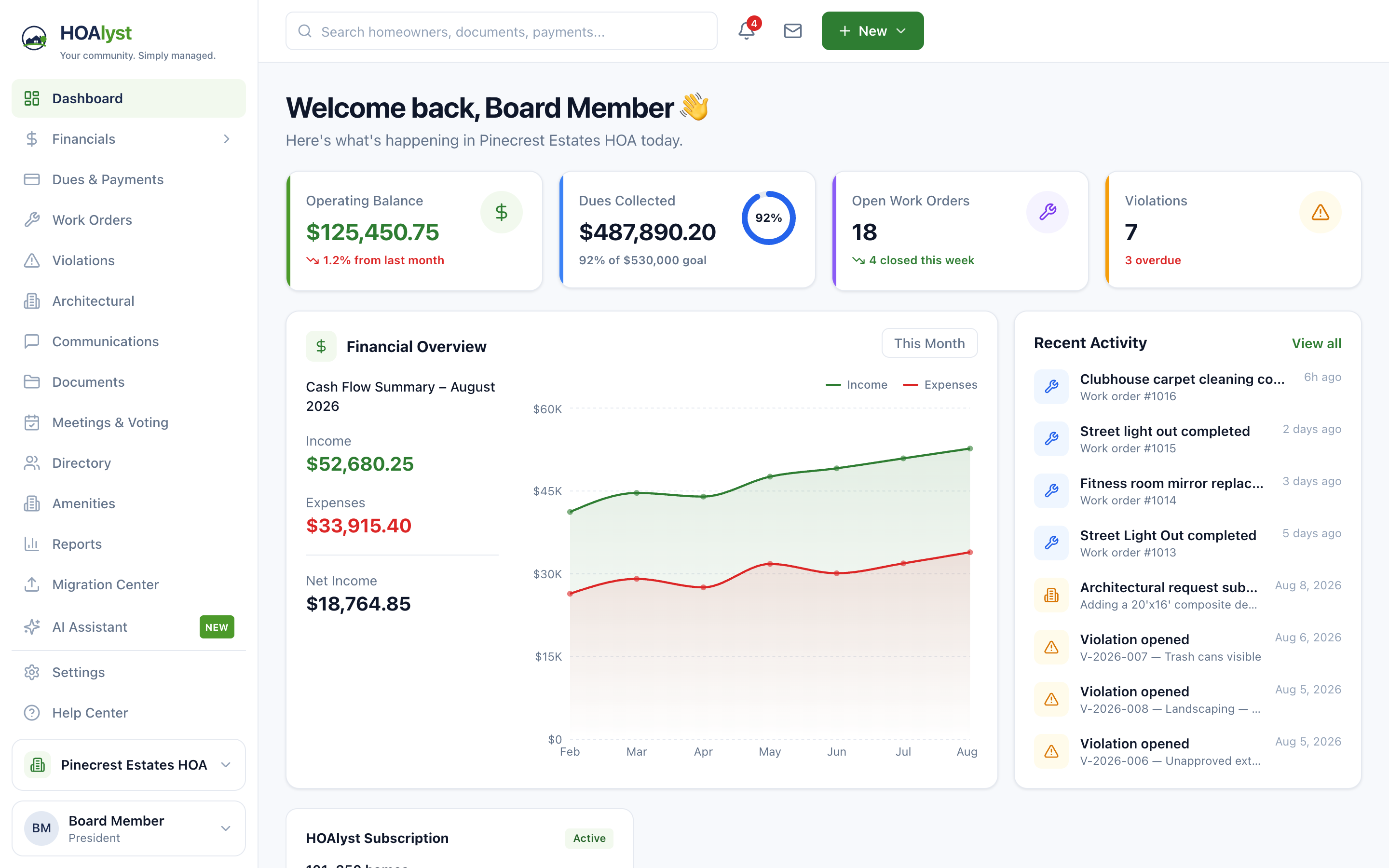
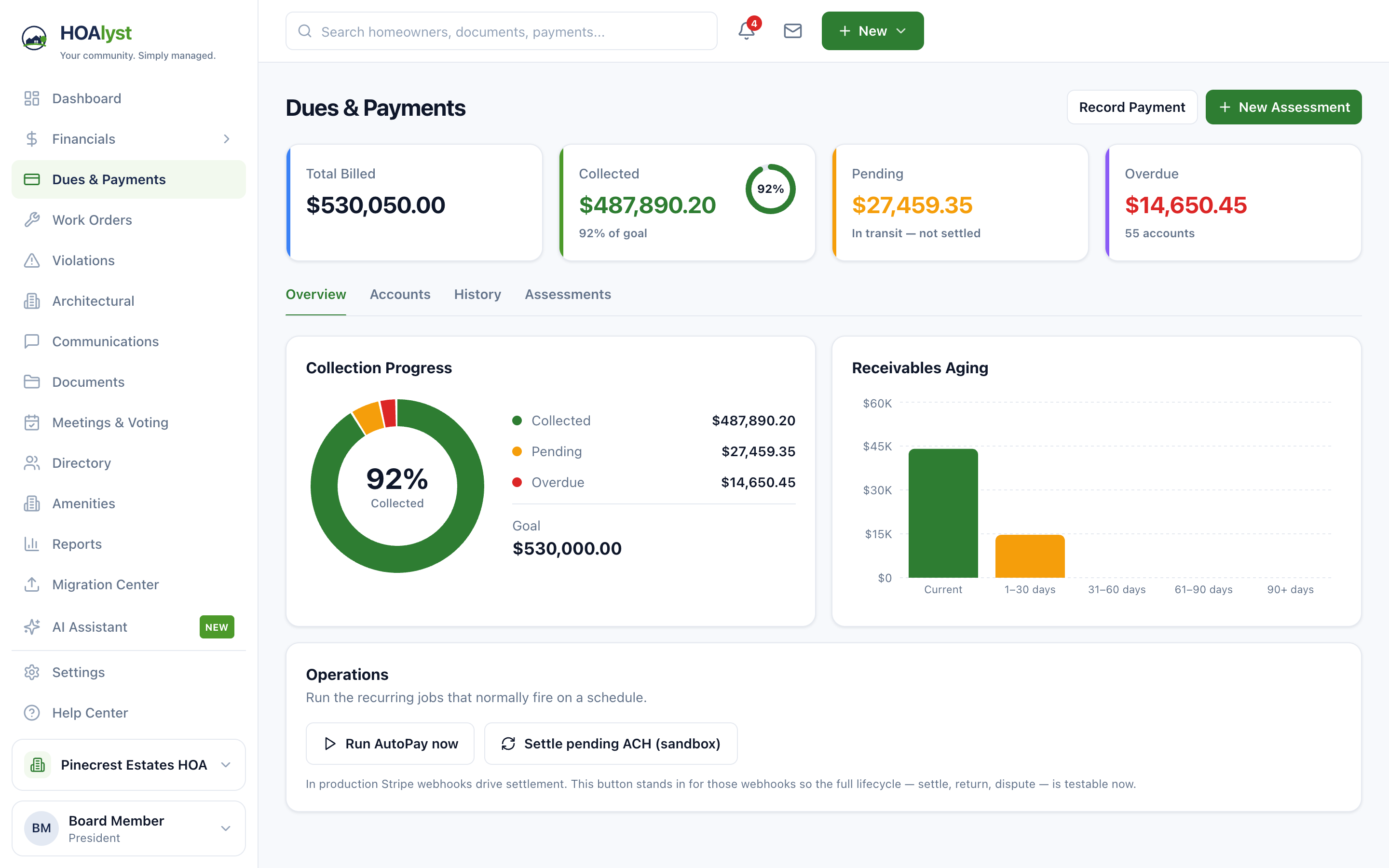
In HOAlyst, the board enters the late fee and grace period it actually adopted, and until it does, no late fee is charged or mentioned to owners. Before any fee is applied, the board sees every affected home by name with how many days late it is and the fee, and confirms the list; the system will not raise a second late fee on the same charge. Owners see each charge on their ledger in the owner portal and mobile app, can pay by bank transfer or card, and can turn on autopay so they are not late in the first place. See what boards get or try the demo with a sample association.
Late fee checklist for boards
- Declaration and bylaws checked for authority to charge a late fee, interest and collection costs.
- State law checked for caps, payment-application order and notice before collection.
- Amount and grace period adopted by board vote at a noticed meeting and recorded in the minutes.
- Written collection policy sent to every owner.
- Late fees applied the same way to every owner, once per late installment.
- Late fees kept separate from fines, which follow the notice and hearing process.
- Waiver rule written down and each waiver recorded.
- Collection steps escalated only after the required written notice.
This article is general information for community association boards, not legal advice. Laws differ by state and change over time, and your association's declaration, bylaws and rules may set different requirements. Check your governing documents, and ask your association's attorney before acting on a specific situation.