Finances
HOA Special Assessment Rules: A Guide for Boards
What an HOA special assessment is, who can approve one, the notice owners must get, limits and payment plans, and a checklist for boards.
HOAlyst Team · · 8 min read
An HOA special assessment is a one-time or short-term charge, on top of regular dues, that an association levies on every owner to pay for something the budget and reserves do not cover: a new roof, storm damage, a lawsuit, an insurance deductible or a repair that came sooner than planned. The rules come from three places: the declaration (CC&Rs) and bylaws, which say who may approve one and whether there is a cap or an owner vote; state law, which can add notice and voting requirements; and the board's own process. Below is how that usually works, what owners are entitled to know, and a checklist for boards.
Special assessments are common because most community associations fund large repairs from a mix of reserves and owner contributions. The Foundation for Community Association Research estimates there are 373,000 community associations in the U.S., and every one of them will eventually face a cost larger than its budget planned for. How a board handles that moment shapes owner trust for years.
This article is general information, not legal advice. Your association's governing documents (the declaration or CC&Rs, the bylaws and the articles of incorporation) and your state's law control who may levy a special assessment, how much, with what notice and with what vote. Where we quote a statute, it is an example from one state. Ask your association's attorney before levying a large assessment or one you expect owners to challenge.
What counts as a special assessment
Regular assessments (dues) pay for the annual budget: operating costs and planned contributions to reserves. A special assessment is anything levied outside that budget for a specific purpose. Common reasons:
- A major repair or replacement that reserves cannot fully cover, such as a roof, paving, siding, a pool or an elevator.
- Storm, fire or flood damage, including the association's insurance deductible.
- An insurance premium increase the budget did not anticipate.
- Legal costs or a judgment against the association.
- Required inspections, engineering or structural work.
- A capital improvement the owners voted to add.
Some declarations also allow an "individual" or "specific" assessment charged to one owner, for example to recover the cost of damage that owner caused. That is a different tool with its own rules; this article covers assessments charged to all owners.
Who can approve a special assessment
Start with the declaration and bylaws. They usually take one of these approaches:
- The board may levy any special assessment by a board vote at a properly noticed meeting.
- The board may levy up to a cap (often a dollar amount per unit, or a percentage of the annual budget) and anything above the cap needs an owner vote.
- Any special assessment for a capital improvement, as opposed to a repair, needs an owner vote, sometimes a supermajority.
- Emergency repairs may be levied by the board alone, whatever the cap, when health, safety or the property is at risk.
Read the exact wording. "Majority of owners present at a meeting" and "majority of the total voting interests" are very different thresholds, and quorum rules apply to any owner vote. Our guides to HOA quorum requirements and HOA online voting cover how those votes are counted.
Example: Virginia
Virginia's Property Owners' Association Act gives boards a baseline power. In addition to the assessments the declaration authorizes, the board may levy an additional assessment if the board finds the purpose is in the best interests of the association and the proceeds are used primarily for the maintenance and upkeep of the common area and other areas of association responsibility, including maintenance, repair and replacement of capital components (Va. Code § 55.1-1825(A)). Unpaid additional assessments carry the association's statutory lien, and the association may deny a nonpaying member access to common areas, though not direct access to their own lot over a common area (Va. Code § 55.1-1825(B)-(C)).
Notice owners must get
Even where the board alone may levy an assessment, owners are usually entitled to notice before the vote. State law often sets a longer notice period for meetings that consider assessments than for ordinary board meetings, and the notice must say that assessments will be on the agenda.
In Florida homeowners' associations, an assessment may not be levied at a board meeting unless the notice of the meeting includes a statement that assessments will be considered and the nature of the assessments, and written notice of any meeting at which special assessments will be considered must be mailed, delivered or electronically transmitted to the members and posted conspicuously on the property not less than 14 days before the meeting (Fla. Stat. § 720.303(2)(c)2).
Florida condominiums have a parallel rule. Written notice of a meeting at which a nonemergency special assessment will be considered must be mailed, delivered or electronically transmitted to unit owners and posted conspicuously at least 14 days before the meeting, with an affidavit of compliance filed in the official records (Fla. Stat. § 718.112(2)(c)1). The notice must specifically state that assessments will be considered and give the estimated cost and a description of their purposes (Fla. Stat. § 718.112(2)(c)3).
Our guide to HOA board meeting notice requirements covers how to send and document notice so it holds up.
Purpose and use of the money
A special assessment is raised for a stated purpose, and many states and declarations hold the association to it. In Florida condominiums, the specific purpose of any special assessment must be set forth in a written notice sent or delivered to each unit owner, the funds collected may be used only for that purpose, and any excess after the purpose is completed is common surplus that the board may return to owners or credit toward future assessments (Fla. Stat. § 718.116(10)).
Even where no statute says so, it is good practice everywhere: name the project, keep the money in a separate account or a clearly tracked fund, report spending against it, and decide in advance what happens to any surplus.
Are there limits on how much an HOA can charge?
Usually the limit is in the declaration, not state law. Look for a cap on special assessments per year, a cap tied to the annual budget, or a rule that anything above a threshold needs an owner vote. Some states set limits for some kinds of associations; check your state statute and ask your attorney if the amount is large. If the declaration has no cap and the board followed the notice and vote rules, a court will usually look at whether the board acted within its authority and in good faith, not at whether the amount was popular.
Payment plans and due dates
A large assessment due in one payment is the fastest way to create delinquencies. Many boards offer a choice: pay in full by a date, or pay in equal installments over several months. Before offering installments, check whether the declaration allows them, whether interest or late fees apply to installments, and whether the board must offer the same terms to every owner (it almost always should). Put the full amount, the due date for each installment and the late fee rules in writing in the assessment notice.
What owners can do
Owners who disagree with a special assessment have a few legitimate options: attend the meeting and speak, ask to see the bids, engineering reports and reserve study behind the number, request the association's records, and, where the documents require an owner vote, vote against it. Owners who think the board skipped a required notice or vote should read the governing documents and talk to their own attorney. Not paying is rarely a good strategy: an unpaid assessment is usually secured by the association's lien, with late fees and collection costs added.
Where HOAlyst fits
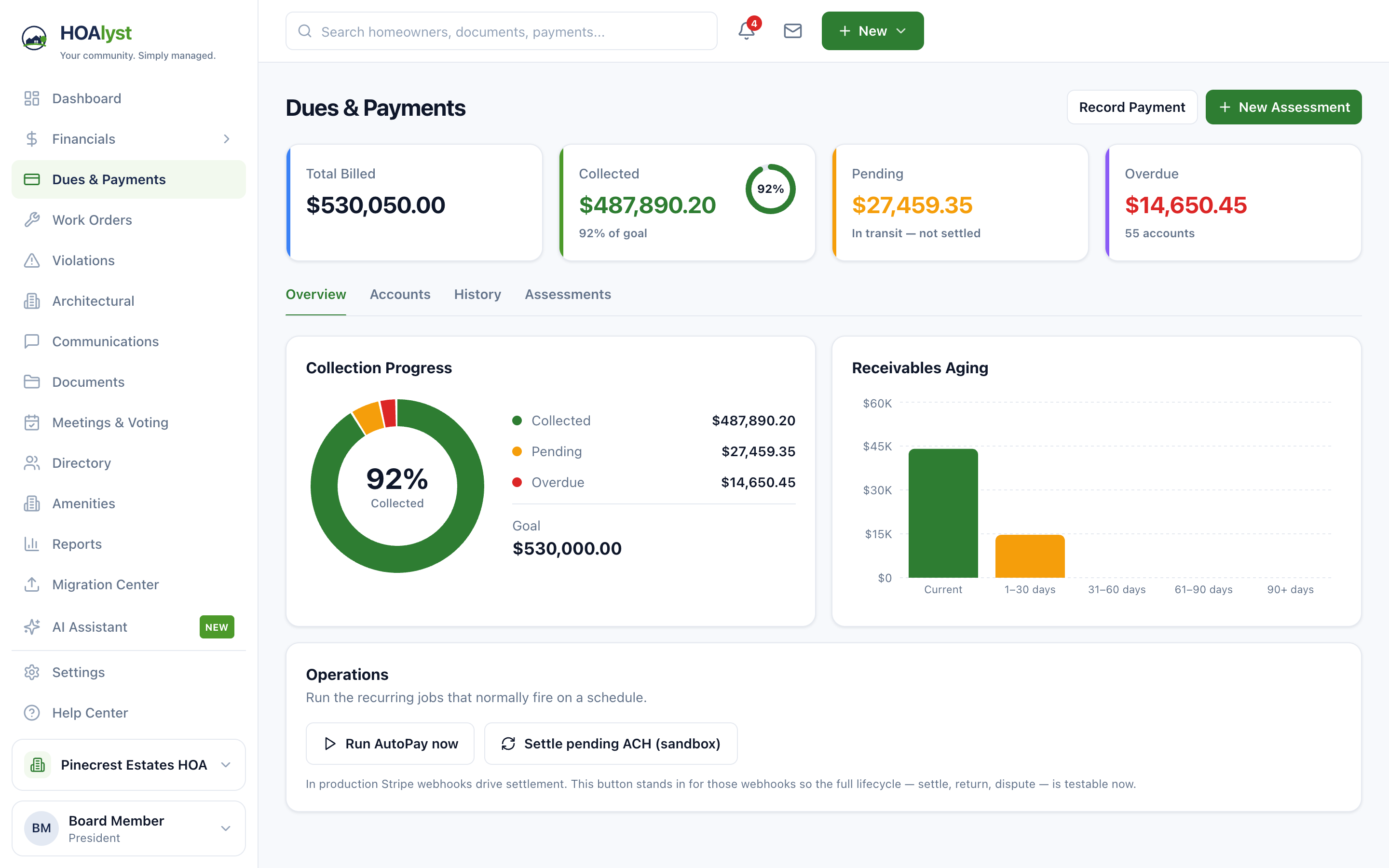
In HOAlyst, the board creates a special assessment from the dues screen with a name, an amount per unit, a due date and a description of the purpose, then bills every property at once; each owner gets a notice and sees the charge itemized on their ledger in the owner portal and mobile app, where they can pay by bank transfer or card. When owners must approve the assessment, the board can run the vote electronically with a majority or supermajority threshold and quorum tracked. See what boards get or try the demo with a sample association.
Special assessment checklist for boards
- Declaration, bylaws and articles checked: who may levy, any cap, any owner vote, and the emergency exception.
- State law checked for notice periods, vote thresholds and rules on use of funds.
- The need documented: bids, engineering or insurance reports, and why reserves do not cover it.
- Meeting noticed with the required lead time, stating that an assessment will be considered, its estimated cost and its purpose.
- Owner vote held where required, with quorum and the right threshold.
- Motion recorded in the minutes: amount per unit, how it is allocated, purpose, due dates and any installment option.
- Written assessment notice sent to every owner, with payment instructions.
- Funds tracked separately, spending reported, and any surplus handled as the documents or law require.
This article is general information for community association boards, not legal advice. Laws differ by state and change over time, and your association's declaration, bylaws and rules may set different requirements. Check your governing documents, and ask your association's attorney before acting on a specific situation.