Violations
HOA Fine Hearing: Notice, Process and Rights
How an HOA fine hearing works: the notice, who decides, what happens at the hearing, the written decision, appeals, and state-law examples.
HOAlyst Team · · 7 min read
An HOA fine hearing is the owner's chance to be heard before the association imposes a fine or suspends a right for a rule violation. In most associations it works the same way: the owner gets written notice of the violation and the hearing, a board or committee listens to the owner and looks at the evidence, it decides whether to confirm, reduce or reject the fine, and it sends the result in writing. Whether a hearing is required, how much notice is due and who sits on the panel depend on your state's law and your association's governing documents.
Fines are one of the few tools a volunteer board has to enforce its rules, and they are also one of the most common sources of disputes. With an estimated 373,000 community associations in the U.S. according to the Foundation for Community Association Research, most of these hearings are run by neighbors, not lawyers. A fair, predictable process protects the owner, and it protects the board when a fine is challenged later.
This article is general information, not legal advice. Your state's statutes and your association's declaration or CC&Rs, bylaws and adopted rules control whether the association may fine at all, how much, and what process it must follow. Where we quote a statute, it is an example from one state. Ask your association's attorney before adopting a fine policy or imposing a fine.
Is a hearing required before an HOA fine?
Often, yes. Many states require notice and an opportunity to be heard before a fine or a suspension of common-area rights, and many governing documents require a hearing even where state law is silent. Some states also require the right to the hearing to be stated in the notice itself. Even where nothing requires one, offering a hearing is good practice: it catches mistakes, lets owners explain, and builds a record that the fine was fair.
Start with three questions:
- Do our documents expressly allow fines, and is there an adopted fine schedule?
- Does our state require notice, a hearing, a particular panel, a delivery method or a limit on the amount?
- Has the board adopted a written enforcement or hearing policy, and are we following it?
The hearing notice
The hearing notice is usually the most technical letter in the whole process. It typically includes:
- The owner's name and property address, sent to the address in the association's records.
- A description of the alleged violation, with dates, and the exact document section relied on.
- The action the owner can take to cure it, if a cure is possible.
- The proposed fine or suspension, stated as your documents allow.
- The date, time and place of the hearing, and access details if the owner may attend by phone or video.
- The owner's right to attend, speak, bring documents or witnesses and, where state law allows, be represented by a lawyer.
Our HOA violation letter template covers the letters that come before this one. A hearing notice should follow the same ladder and repeat the facts from the earlier notices rather than adding new ones.
Who decides: the board or an independent committee
Depending on your state and documents, the hearing may be in front of the full board, a covenants or hearing committee, or a panel the documents name. Some states require a panel of owners who are not on the board. Whoever hears it, the people deciding should not include anyone with a personal stake in the dispute, such as the neighbor who complained or a director in a feud with the owner. If your documents are silent, a written policy that names the panel in advance avoids arguments about fairness later.
What happens at an HOA fine hearing
A typical hearing is short and informal. It is not a trial, but it should follow a consistent order:
- The chair opens the hearing, confirms who is present and explains the order of business.
- The board or manager summarizes the violation, the rule, the notices sent and any photos or inspection notes.
- The owner responds: they may deny the violation, explain circumstances, show it has been cured, or ask for more time.
- The panel asks questions of both sides.
- The panel decides, either at the hearing or shortly afterward, and the decision is recorded.
Many boards hold violation hearings in executive session, because they involve an individual owner, and then record only the action taken. Our guide to HOA executive session rules explains when that is allowed, and our HOA meeting minutes guide covers how to record the decision.
Example: Florida homeowners' associations
Florida's homeowners' association statute is one of the most detailed. A fine or suspension may not be imposed unless the board first gives at least 14 days' written notice of the owner's right to a hearing, sent to the owner's mailing or email address in the official records (Fla. Stat. § 720.305(2)(b)). The hearing must be held within 90 days after the notice, before a committee of at least three members appointed by the board who are not officers, directors or employees of the association, or a spouse, parent, child, brother or sister of one. The committee may hold the hearing by phone or other electronic means, and the owner has the right to attend that way. The notice must describe the violation, the specific action needed to cure it, and the hearing date, location and access information.
The committee's role is limited: it confirms or rejects the fine or suspension the board levied, and if a majority does not approve it, it may not be imposed (Fla. Stat. § 720.305(2)(c)). Within 7 days after the hearing, the committee must send written findings, including how to cure and the date a fine must be paid, and if the violation was cured before the hearing or in the way the notice specified, no fine or suspension may be imposed (Fla. Stat. § 720.305(2)(d)-(e)). Fines are capped at $100 per violation and $1,000 in total for a continuing violation unless the governing documents provide otherwise.
Example: Florida condominiums
Florida's condominium statute uses a similar model with different details. It requires at least 14 days' written notice and an opportunity for a hearing before a committee of at least three members who are not officers, directors or employees, and the committee may only confirm or reject the fine or suspension (Fla. Stat. § 718.303(3)(b)). If the committee approves it, the fine payment is due 5 days after notice of the approved fine is provided. The condominium statute caps fines at $100 per violation and $1,000 in the aggregate, and says a fine may not become a lien against a unit (Fla. Stat. § 718.303(3)).
Example: Virginia
Virginia's Property Owners' Association Act and its Condominium Act follow the same pattern. Before charges are assessed, the owner must get written notice and a reasonable opportunity to correct the violation, and if it is not corrected, an opportunity to be heard and to be represented by counsel before the board or another tribunal the documents specify (Va. Code § 55.1-1959(C); for property owners' associations, § 55.1-1819). Notice of the hearing, including the actions the association may take, must be hand delivered or sent by registered or certified mail, return receipt requested, at least 14 days in advance, and the result must be delivered the same way within seven days after.
Virginia caps the charges: no more than $50 for a single offense or $10 per day for a continuing one, and a continuing offense may not be charged for more than 90 days (Va. Code § 55.1-1959(D)). If your state has rules like these, build your hearing notice and decision letter around them, because a fine imposed without the required process may not hold up.
The written decision
Whatever your state requires, send the owner a written decision after every hearing, even when the fine is dropped. It should state what the panel found, whether the fine or suspension was confirmed, reduced or rejected, the amount and payment date if any, how to cure, and how to appeal if your documents allow one. Use the delivery method your documents and state law require, and keep a copy with the notices, photos and hearing notes in the case file.
Appeals and disputes
Some documents give owners a further appeal, for example from a committee to the full board, with a set time to file. Others treat the hearing decision as final within the association. Either way, an owner who disagrees can usually still raise the matter with the association's attorney or pursue the remedies state law provides. For the board, the best defense is a record that shows the same process was followed for every owner with a similar violation.
Where HOAlyst fits
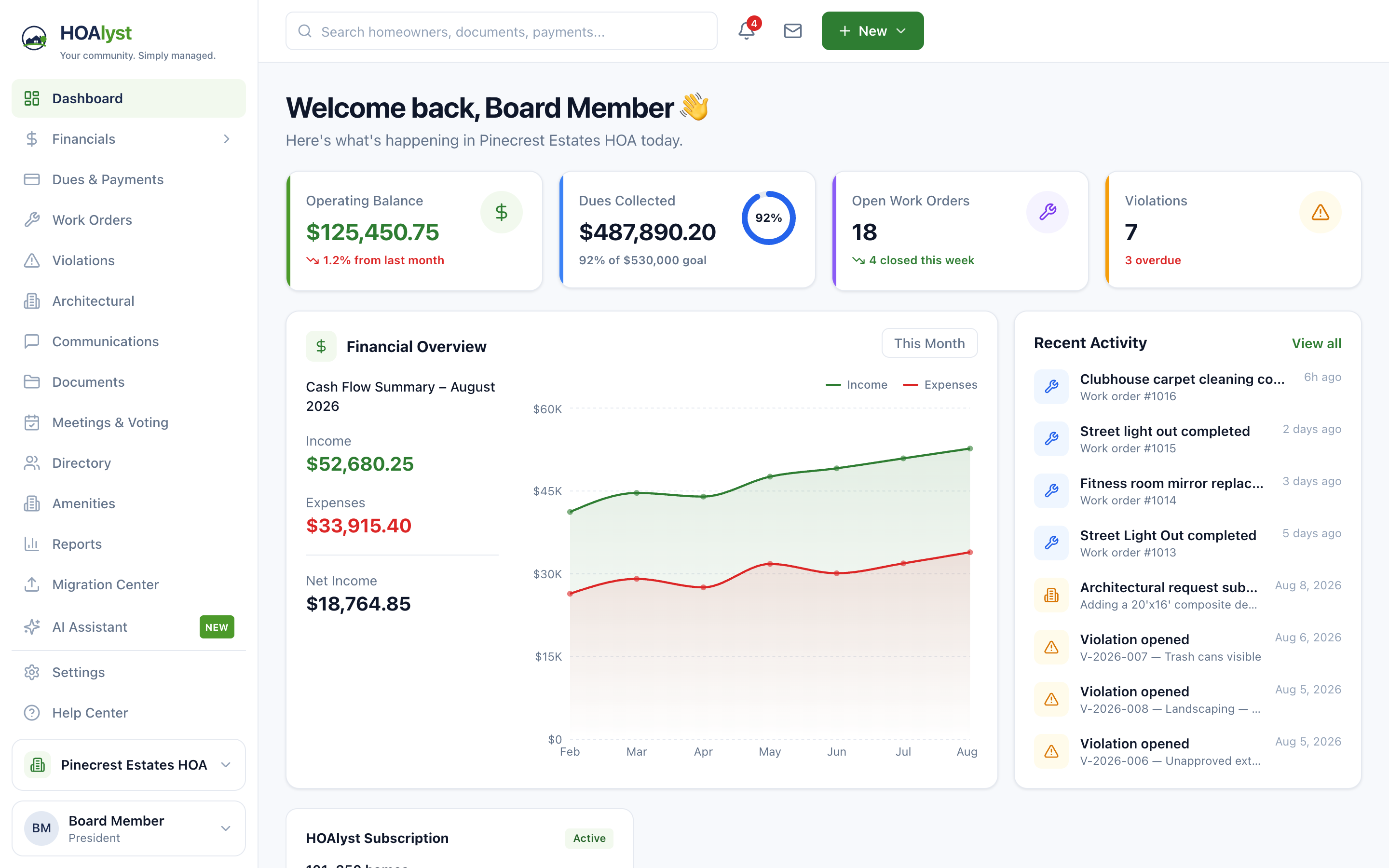
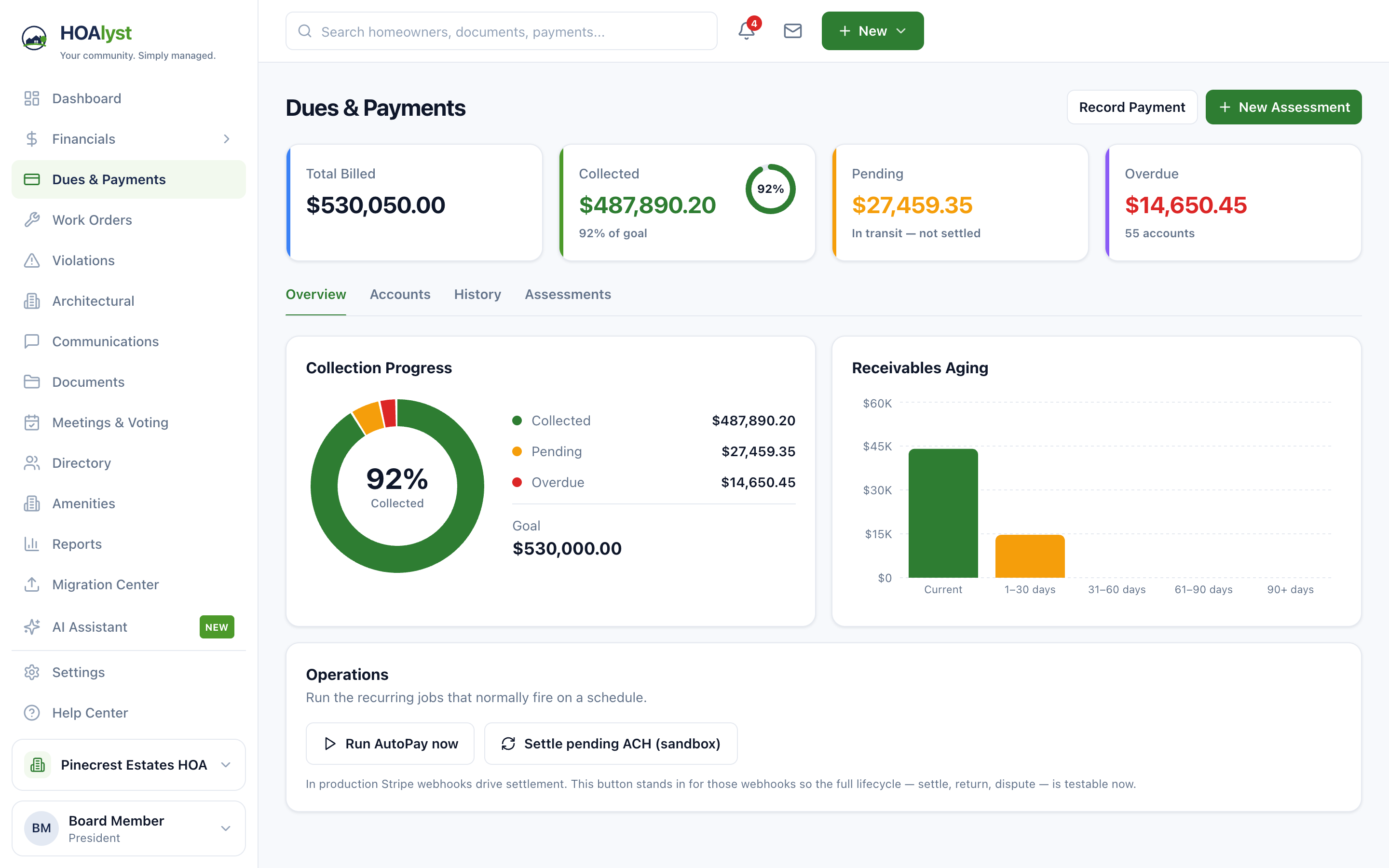
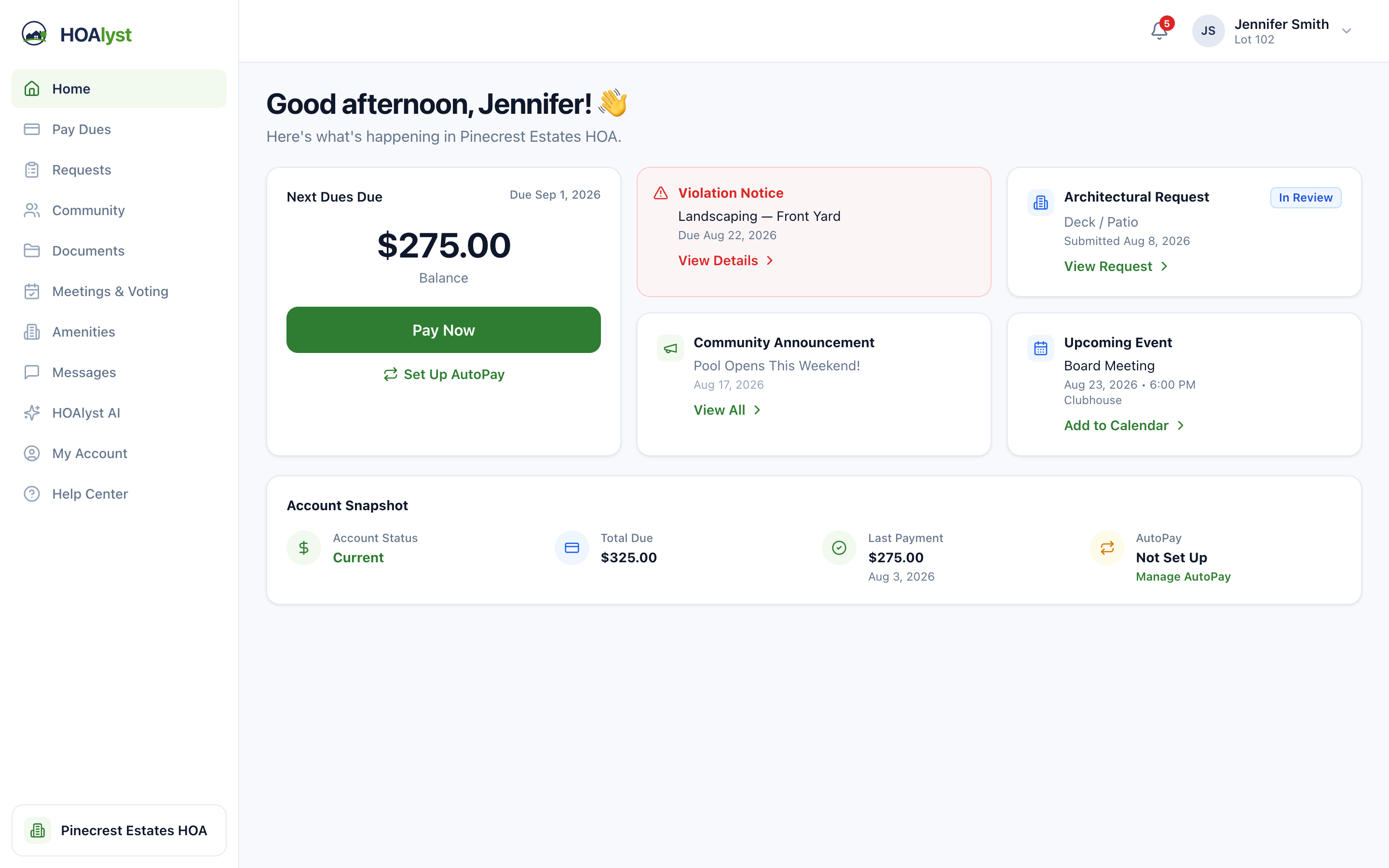
In HOAlyst, each violation case tracks its notices, the owner's response or dispute from the owner portal, and the hearing: the board schedules it, records when it was held, and records the outcome (upheld, dismissed, reduced or deferred) with notes. A board-approved fine posts to the owner's account, the owner can appeal it, and the appeal can go to the board or to a committee set up to hear appeals, with every step on the case timeline. See what boards get or try the demo with a sample association.
Fine hearing checklist
- Documents checked: fines allowed, fine schedule adopted, hearing policy in place.
- State law checked for notice period, delivery method, panel, amount limits and timing of the decision.
- Hearing notice describes the violation, the rule, the cure and the hearing details.
- Panel chosen in advance, with no one who has a personal stake.
- Hearing held in the same order every time, and the owner allowed to respond.
- Cure checked before the hearing; no fine if the law or documents bar one after a cure.
- Written decision sent by the required method, with payment date and any appeal rights.
- Case file kept: notices, photos, hearing notes, decision and proof of delivery.
This article is general information for community association boards, not legal advice. Laws differ by state and change over time, and your association's declaration, bylaws and rules may set different requirements. Check your governing documents, and ask your association's attorney before acting on a specific situation.