Self-managed
Self-Managed HOA Software: What to Look For
What a self-managed HOA board needs from software: dues, records, meetings, violations and an owner portal, plus how to compare options before switching.
HOAlyst Team · · 7 min read
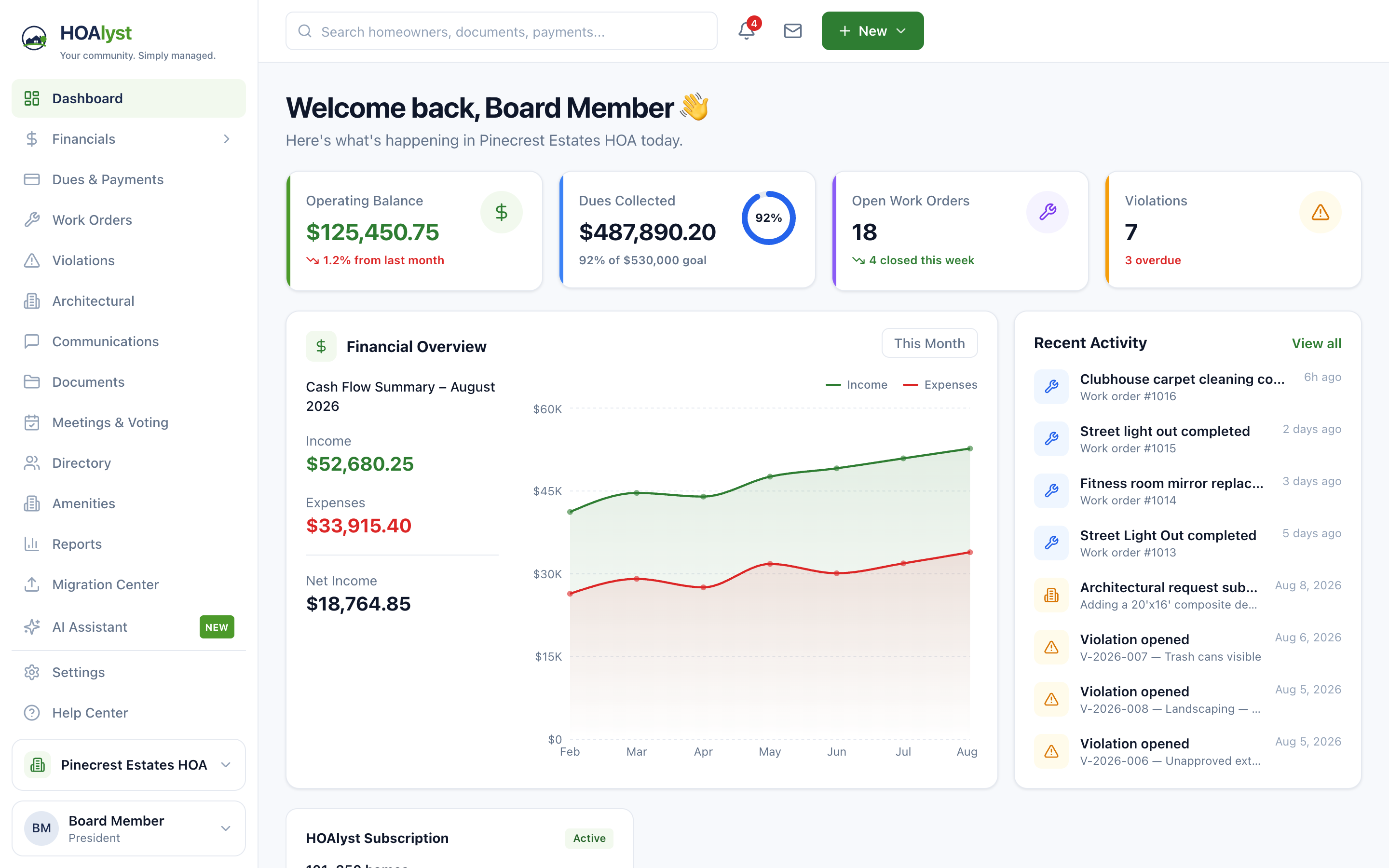
Self-managed HOA software is a tool that lets a volunteer board do the jobs a management company would otherwise do: collect dues and track each owner's balance, keep the association's records, run meetings and votes, handle violations and architectural requests, and give owners one place to pay, read documents and ask questions. The right one is the one that covers the jobs your board actually does, keeps records your state and documents require, and that the next board can pick up without a handover weekend.
It is a common situation. The Foundation for Community Association Research reports that more than one third (35.2%) of U.S. housing is in a community association, and it estimates 373,000 associations nationwide. Many smaller ones are run entirely by volunteers, often with a spreadsheet, a shared email inbox and a folder of scanned documents.
This article is general information, not legal advice. What your association must collect, record, notice and keep comes from your state's law and your own governing documents: the declaration (often called the CC&Rs), the bylaws, and the rules the board has adopted. Where we quote a statute, it is an example. Ask your association's attorney before relying on any of it for a decision that matters.
Start with the jobs, not the features
Before comparing products, write down what your board does in a normal year and who does it. For most self-managed associations the list looks like this:
- Bill dues or assessments, record payments, follow up on late accounts, and keep each owner's ledger.
- Pay the bills, prepare a budget, and report to owners on the finances.
- Schedule board and annual meetings, send the agenda, record the minutes, and hold elections or other votes.
- Send violation notices, give owners a chance to cure or be heard, and keep a record of each step.
- Review architectural requests (a fence, a roof color, a shed) and record the decision.
- Store the governing documents, contracts, insurance policies and past minutes, and answer owner records requests.
- Take maintenance requests and track the work, and manage shared amenities such as a clubhouse or pool.
Then mark which of those cause the most trouble today. A board that loses hours each month reconciling dues needs strong payment tracking first. A board fighting about a fine that was never documented needs violation records. Software that does everything on paper but nothing well for your top two problems is the wrong choice.
Dues and the owner ledger
For most boards this is the core of the decision, because it is money and it is where records matter most. Virginia's Property Owners' Association Act, for example, requires an association to keep detailed records of receipts and expenditures in accordance with generally accepted accounting practices and to maintain individual assessment account records (Va. Code § 55.1-1815). Your state may phrase it differently, but the expectation is the same: you should be able to show any owner what they were charged, what they paid and when.
Look for:
- A ledger per owner or unit, with charges, payments, late fees and credits, that the owner can see too.
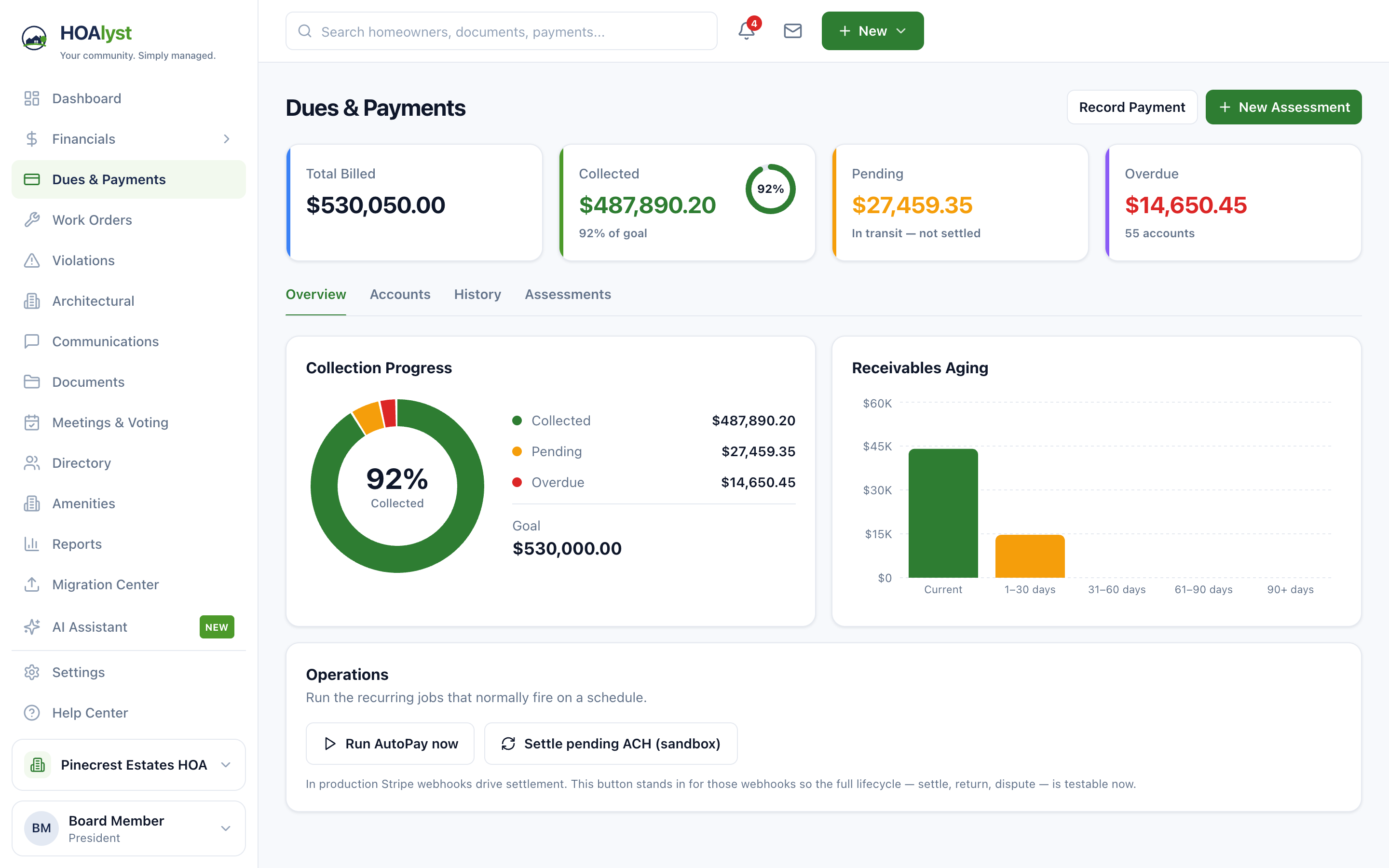
- Online payment by bank transfer (ACH) and card, with autopay, so fewer owners pay late in the first place.
- Clear reports for the treasurer: who is current, who is behind and by how much, and what came in this month.
- An easy way to export the data, so the association owns its records no matter what tool it uses.
Ask how payouts work, who the payment processor is, and what fees owners or the association pay per transaction. Those terms vary from product to product, so get them in writing before you move owners over.
Records owners can reach
Owners generally have a right to inspect association records, and some states now expect associations to put key documents online. Florida is the clearest example. Its homeowners' association statute requires an association with 100 or more parcels to post documents such as its articles, bylaws, declaration, current rules, annual budget and meeting notices on a website or a mobile app, with a protected section that only parcel owners and association employees can reach (Fla. Stat. § 720.303(4)(b)).
Even if your state asks for less, a single document library with search saves the board time. Owners who can find the rules and the latest minutes themselves send fewer emails. If your state does set specific posting requirements, compare the requirement line by line against what the software actually does, and ask your attorney whether that is enough.
Meetings and votes
Meetings are where self-managed boards are most exposed, because a vote taken without proper notice or a quorum can be challenged. Useful features here include a meeting calendar with agendas, a way for owners to RSVP, minutes the board can draft and then publish, and electronic voting that shows how many eligible owners have voted against the quorum required. Check first that your state law and your bylaws allow electronic voting for the kind of vote you have in mind.
Our guides on how to run an HOA board meeting and HOA meeting minutes requirements cover the process itself; software should make that process easier to follow, not replace it.
Violations and architectural review
Enforcement is where documentation pays for itself. Most governing documents and many state statutes require some form of notice and an opportunity to be heard before a fine. Software that records each step (the observed violation, the notice sent, the cure period, any hearing and the outcome) gives the board a record it can point to. The same goes for architectural requests: a submitted form, the committee or board decision, and the date, stored where the next board can find it.
Free tools versus dedicated software
Plenty of small associations run on free tools: a spreadsheet for dues, a shared drive for documents, and email for everything else. That can work while one dedicated volunteer holds it together. The trouble usually starts when that volunteer leaves the board. The spreadsheet formulas, the folder structure and the history of every owner conversation leave with them.
Dedicated software costs money, so weigh it against what the board is actually spending in volunteer hours, late payments and records requests. Whatever you choose, make sure the association, not an individual director, owns the account and the data. If the board is still deciding whether to manage itself at all, start with the pros and cons of a self-managed HOA.
Questions to ask before you switch
- Does it cover our top two problems well, not just list them as features?
- What does it cost, per unit or flat, and are there per-payment fees for owners?
- Can owners pay, read documents and see their balance on their phone?
- Can more than one director have access, with different permissions, so the treasurer isn't the only one who can see the books?
- How do we bring in our existing owner list and balances, and how do we get our data out if we leave?
- Can a new board member pick it up in an afternoon?
Try it with your own scenario before you commit: enter a payment, send a test notice, publish a document, and look at it from an owner's side.
Where HOAlyst fits
HOAlyst is built for self-managed boards. Owners pay dues by ACH or card with autopay, the board tracks each owner's balance, and the same place handles meetings with agendas and published minutes, electronic votes with quorum counts, violations with cure periods, notices and hearings, architectural review requests, document storage and search, amenity reservations and work orders. Owners use a portal on the web or the mobile app. See what boards get, check pricing, or try the demo with a sample association.
Self-managed software checklist
- Board jobs listed, and the top two problems named.
- Per-owner ledger, online payments with autopay, and treasurer reports.
- Document library owners can search, checked against any state posting rules.
- Meetings, minutes and votes that follow your bylaws and state law.
- Violation and architectural records with every step dated.
- Association-owned account, more than one director with access, and a way to export the data.
This article is general information for community association boards, not legal advice. Laws differ by state and change over time, and your association's declaration, bylaws and rules may set different requirements. Check your governing documents, and ask your association's attorney before acting on a specific situation.