Self-managed
Self-Managed HOA Pros and Cons: How to Decide
The real pros and cons of a self-managed HOA: what you save, what the board takes on, and how to tell whether your association should manage itself.
HOAlyst Team · · 7 min read
A self-managed HOA is one run by its volunteer board instead of a paid management company. The main pros are lower cost, closer control and quicker decisions by people who live in the community. The main cons are the time it takes, the risk of mistakes on money and legal deadlines, and how much depends on a few volunteers. It tends to work when the association is small, its finances are simple and at least two or three people will reliably do the work. It tends to fail when all of that rests on one person.
The choice affects a lot of households. The Foundation for Community Association Research estimates there are 373,000 community associations in the U.S., home to 78.1 million residents. They range from a handful of townhomes to large master-planned communities, so no single answer fits all of them.
This article is general information, not legal advice. Your state's law and your association's governing documents (the declaration or CC&Rs, the bylaws and the rules) control what the board must do. Some of those documents even say whether a manager is required, so read them before you change anything, and ask your association's attorney before relying on any of this for a real decision.
What self-managed really means
Self-managed does not always mean the board does everything by hand. There is a range, and most associations can choose a point on it:
- Fully self-managed: directors handle the money, records, meetings, enforcement and vendors themselves.
- Self-managed with paid help: the board stays in charge and hires specific jobs out, such as a bookkeeper, a tax preparer, a landscaping contractor or the association attorney.
- Financial-only or partial management: a company handles billing and accounting while the board handles everything else.
- Full-service management: a company runs daily operations and carries out what the board decides.
Even at full service, the board keeps the decisions. A management company works for the association and carries out its direction; hiring one does not transfer the directors' responsibility. That matters for this comparison, because the choice is really about who does the work, not about who answers for it.
The pros of self-management
- Lower cost. Management fees are often one of the larger lines in a small budget. Without them, that money can go to reserves, maintenance or lower dues. Get a real quote before you assume the saving, because the amount depends on your size, location and what the company would actually do.
- Direct control. The board chooses the vendors, sets the priorities and decides how to handle each situation, with no layer in between.
- Local knowledge. Directors see the broken gate or the failing irrigation line themselves, and they know the history of the community.
- Faster answers. In a small association, an owner with a question can reach a person who can actually decide.
- Closer community. Owners who know the people running the association often trust them more, and a board that does the work tends to understand the real cost of each decision.
The cons of self-management
- It takes real time. Billing, bookkeeping, owner questions, vendors, meetings and records add up every month, and it is unpaid time on top of a job and a family.
- The work is concentrated. In many self-managed associations one treasurer or president holds most of it. If that person moves or burns out, the association can lose its process along with its volunteer.
- Mistakes can be expensive. A missed notice deadline, an unsupported fine or a lien handled the wrong way can lead to a dispute that costs more than the fee you saved. Boards without a professional have to catch these themselves.
- Neighbors enforcing rules on neighbors. Sending a violation notice or chasing late dues is uncomfortable when you see the owner at the mailbox. Some boards end up enforcing unevenly, which creates its own problems.
- Less specialist knowledge. A good manager has seen insurance renewals, roof projects and collections many times. A new board may be doing each of them for the first time.
- Handling the money. Self-managed boards need controls of their own, such as two people able to see the bank accounts, and regular reports to the full board, so that no single volunteer holds all of it.
What the law may still require of a volunteer board
Going without a manager does not reduce what the association owes its owners. Directors have legal duties whether or not they are paid. Florida's homeowners' association statute, as one example, says officers and directors have a fiduciary relationship to the members (Fla. Stat. § 720.303(1)). Florida also requires newly elected or appointed directors to complete approved education within 90 days (Fla. Stat. § 720.3033(1)).
Financial reporting rules also apply to volunteers. Florida sets the level of reporting by revenue: an association with total annual revenues of $150,000 or more but under $300,000 prepares compiled statements, and larger ones need reviewed or audited statements, while smaller ones prepare a report of cash receipts and expenditures (Fla. Stat. § 720.303(7)). Virginia requires individual assessment account records and records kept under generally accepted accounting practices (Va. Code § 55.1-1815). Your state's rules may differ, so look up yours rather than assuming these apply.
Paying someone can raise a separate question. Florida's definition of community association management covers listed work done for remuneration for associations with more than 10 units or a budget over $100,000 (Fla. Stat. § 468.431(2)), and Virginia generally requires a license to offer management services to a community, with exemptions (Va. Code § 54.1-2346). So before paying a neighbor to run things, ask your attorney whether that role needs a license in your state.
When self-management tends to work
- The association is small enough that the directors know the owners and the work fits in a few hours a week.
- The finances are simple: regular dues, few vendors and no large project under way.
- At least two or three people will share the work, including someone comfortable with the books.
- Common areas are limited, without major systems such as elevators, a large pool or shared roofs that need constant attention.
- Owners mostly pay on time and disputes are rare.
- The board is willing to pay for help on the hard parts: a CPA, the attorney and insurance advice.
When a manager may be worth it
- Nobody will take the treasurer role, or board seats have been empty for a while.
- The association has many units, multiple buildings, staff or complex shared systems.
- A large project, a serious dispute or a pile of delinquent accounts is under way.
- Directors are in conflict, and a neutral party would help.
- The records are already behind and no one has time to catch up.
The choice is not permanent. Many associations move in both directions as their boards and budgets change. If you are leaving a company, check the contract first for the notice period and how your records and funds get handed back.
How to decide
Treat it like any other board decision, and use real numbers from your own association:
- Check your declaration and bylaws for any requirement to use a manager, and for what owners must approve.
- Get written quotes from a few management companies, and note exactly what each includes.
- List every job the company would do and name the volunteer who would do it instead. An empty name is your answer for that job.
- Estimate the hours per month, and ask whether the current directors can keep that up for years, not just this year.
- Price the paid help you would still need, such as a bookkeeper, a CPA and the attorney. Compare that total to the quote, not zero.
- Plan the handover. Write down how each job gets done, so the next board does not start from nothing.
Then put the discussion on a board agenda and record the decision in the minutes. Our guides to a board meeting agenda and HOA meeting minutes can help, and if you go ahead, this one covers what self-managed HOA software should do.
Where HOAlyst fits
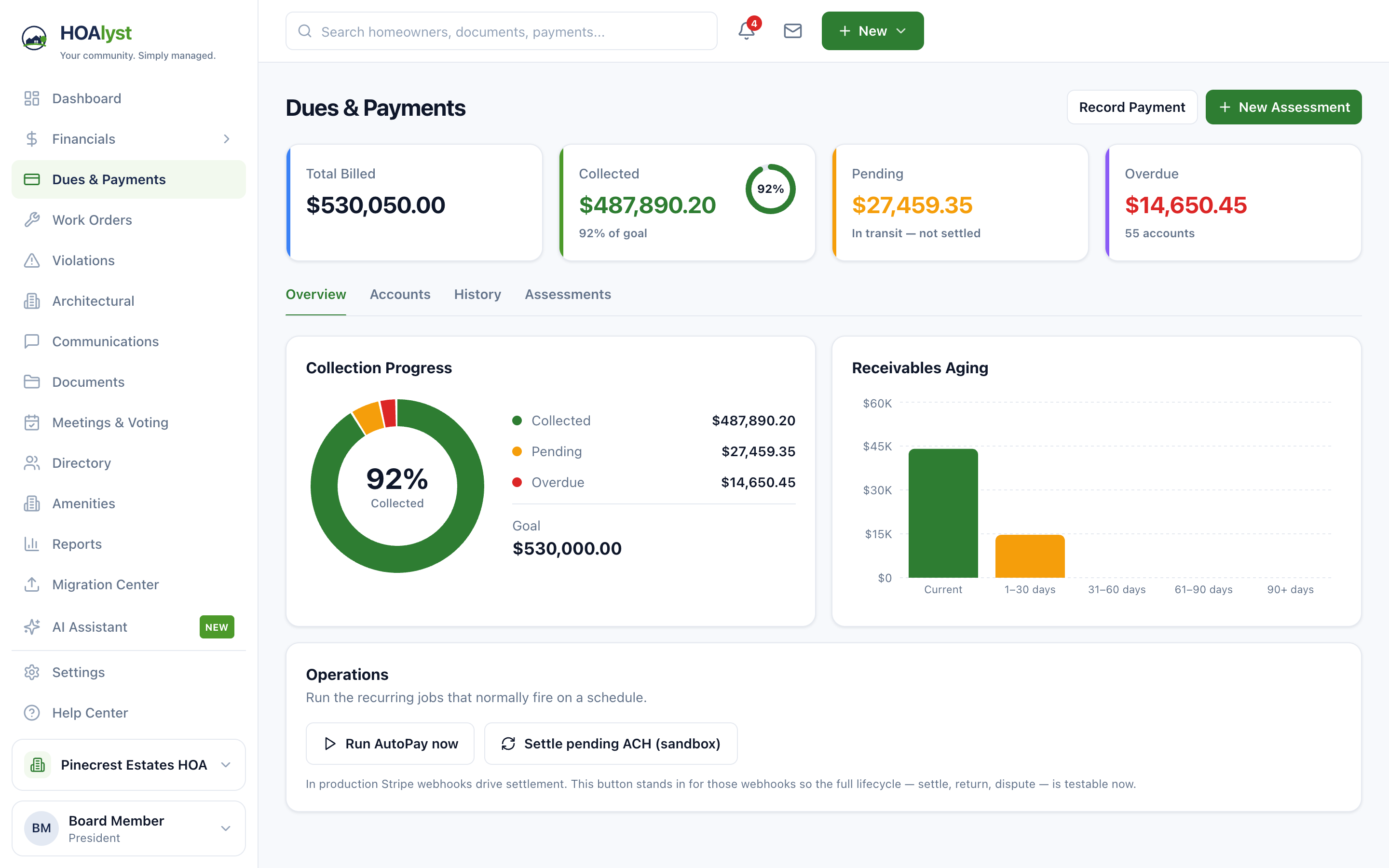
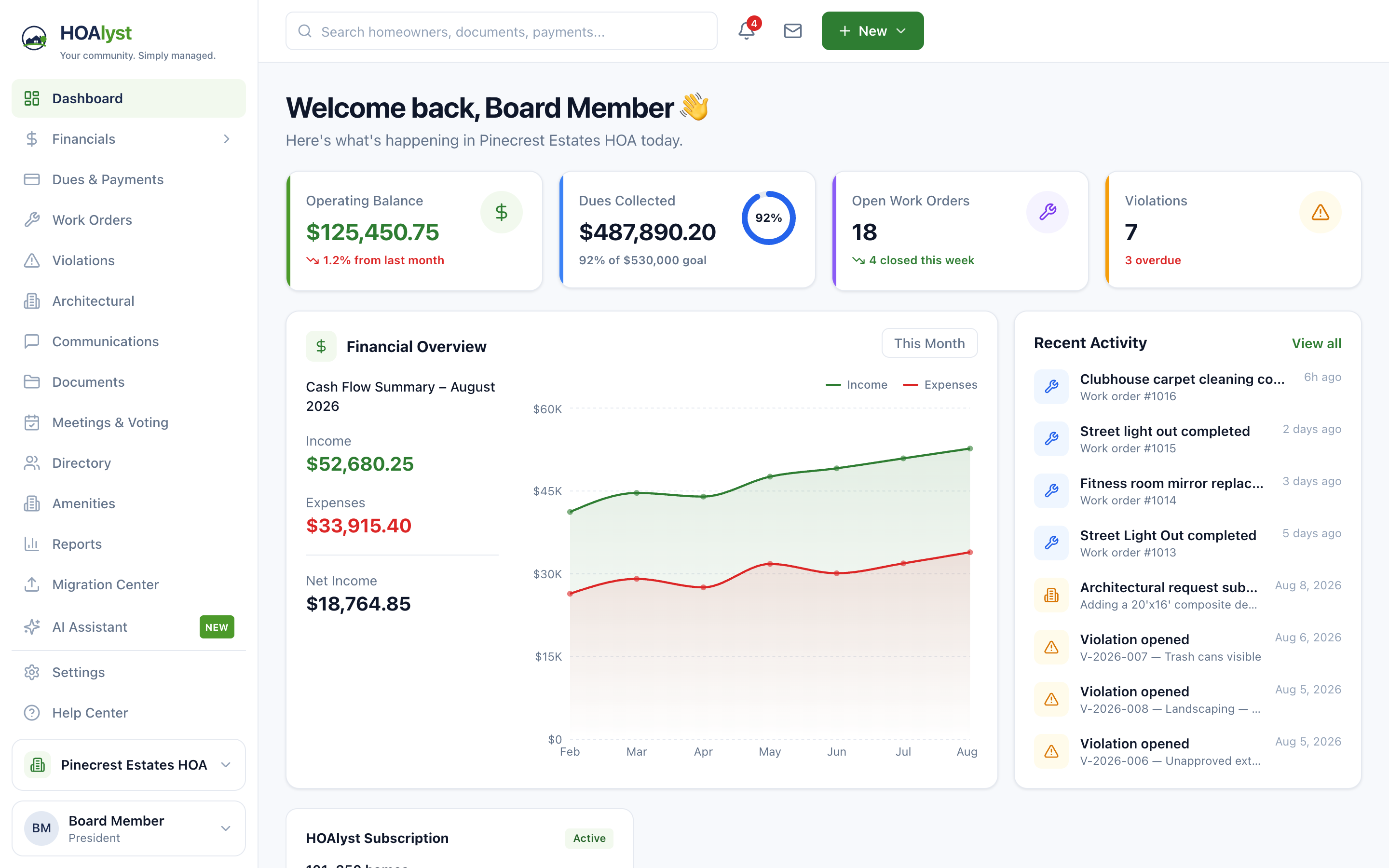
The biggest con of self-management is that everything lives with one volunteer. HOAlyst keeps it in one shared place instead: dues by ACH or card with autopay, each owner's balance, meetings with agendas and published minutes, votes, violations with cure periods and hearings, and stored documents, with an owner portal and mobile app. It does not replace a CPA or an attorney. See what boards get or try the demo with a sample association.
Self-managed HOA decision checklist
- Governing documents checked for any manager requirement.
- Written quotes in hand, with what each one includes.
- A named volunteer for every job, with a backup for the treasurer.
- Hours per month estimated, and the board honest about them.
- State rules looked up for director training, financial reports and manager licensing.
- Cost of paid help added before comparing against a management quote.
- Records, bank access and logins owned by the association, not one person.
- Decision made at a board meeting and recorded in the minutes.
This article is general information for community association boards, not legal advice. Laws differ by state and change over time, and your association's declaration, bylaws and rules may set different requirements. Check your governing documents, and ask your association's attorney before acting on a specific situation.